South Africa’s journey to the semi-finals of the 10th edition of the ICC Women’s T20 World Cup 2026 has been anything but straightforward, a campaign defined by an early stumble, a gritty resurgence, and a late dash to the calculators before Australia finally did them a favour against India.
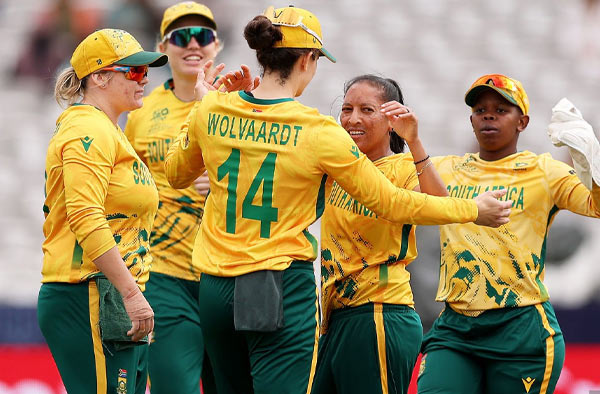
Led by Laura Wolvaardt, the Proteas emerged from a formidable Group A featuring Australia, India, Bangladesh, Pakistan and debutants the Netherlands, stitching together four successive wins after a bruising opening defeat to secure their fourth consecutive, and fifth overall, appearance in the last four of a Women’s T20 World Cup.
Their campaign began on a harsh note in Manchester on 13 June, where Sophie Molineux’s Australia ruthlessly exposed South Africa’s rust and nerves, inflicting a 65-run defeat that immediately pushed the Proteas onto the back foot. In a group where margins were always likely to be tight, such a heavy loss did more than dent confidence; it threatened to haunt their net run rate right through the league phase. Yet, that result also served as an early reality check, sharpening South Africa’s focus and clarifying their route: there was no room left for drift, only for response.
The response started in Birmingham on 17 June in a scrappy, low-scoring contest against Pakistan, where South Africa edged home by 2 wickets. It was the sort of grind that seldom makes highlight reels but often defines campaigns, a reminder that in tournament play, ugly wins count just as much as statement victories. Four days later, back in Manchester on 21 June, came their first true statement: chasing 159 against India, South Africa were under pressure not only from the scoreboard but from the stakes, with India’s superior net run rate looming large over every over of their chase.
That night will be remembered for Marizanne Kapp’s career-best T20I innings, an unbeaten 81 off 45 deliveries from number four that married experience with audacity. Riding her luck through a few reprieves from a misfiring Indian fielding unit, Kapp constructed a chase-defining knock peppered with 7 fours and 4 sixes, lifting South Africa from potential trouble to a commanding six-wicket win with five balls to spare.
Her Player-of-the-Match performance did more than tilt the group; it reaffirmed her status as South Africa’s heartbeat, central with both bat and ball. With the ball, Kapp has been equally pivotal, sitting as the joint leading wicket-taker for South Africa alongside Ayabonga Khaka, with 7 wickets at an average of 14.14 and an economy of 5.21 across five matches, numbers that tell the story of control as much as penetration.
If the India win was about nerve under pressure, Bristol on 25 June offered a different narrative: dominance. Against the Netherlands, the T20 World Cup debutants, Tazmin Brits unfurled her most complete innings in the format, a majestic unbeaten 114 from 69 balls that became her maiden T20I century and the batting centrepiece of South Africa’s 88-run demolition.
Across the group stage, Brits has been the side’s run-scoring pillar, amassing 174 runs in three innings at a strike rate of 134.88 and an astonishing average of 87, placing her at the forefront of South Africa’s top-order resurgence. Her form has provided both scoreboard heft and stability, crucial qualities in a group where every misstep risked elimination.
The final league fixture at Lord’s on 28 June, a four-wicket win over Bangladesh, completed South Africa’s four-match winning streak and kept them in contention, but it still did not guarantee progression. India’s healthier net run rate meant that South Africa, despite their revival, entered the last day’s double-header knowing their fate was no longer in their own hands. In the end, it was Australia who settled the equation, defeating India by six wickets and knocking them out, a result that sealed South Africa’s hold on the fourth and final semi-final berth and underlined how thin the line can be between heartbreak and survival in tournament cricket.
This semi-final qualification extends an increasingly rich chapter in South Africa’s white-ball history. Since their maiden T20 World Cup semi-final in 2014, the Proteas have now reached the last four on five occasions, including a run of four consecutive appearances starting in 2020.
The progression has not stopped there: they broke new ground by reaching their first T20 World Cup final in 2023 under Sune Luus and backed it up by returning to the final in 2024 under Wolvaardt’s leadership, only to finish runners-up on both occasions, to Australia by 19 runs in Cape Town in 2023 and to New Zealand by 32 runs in Dubai in 2024. That history gives this 2026 campaign a clear emotional through-line: a team repeatedly on the cusp, still chasing the final step.
Standing between them and a third straight final are the inaugural champions and hosts, England, unbeaten in Group B and topping their pool with a perfect 10 points from five matches. The second semi-final, set for 2 July 2026 at the Kennington Oval in London and scheduled to start at 11 PM IST, pits South Africa’s hardened, battle-tested unit against a home side that has not yet been pushed to the brink in this tournament.
For Laura Wolvaardt’s South Africa, the path to this semi-final has already demanded resilience, adaptability and the ability to ride small moments of fortune. The question now is whether those same qualities can carry them one step further, from consistent contenders to champions at last.

Loves all things female cricket