Cricket’s return to the Olympic Games is not much about reinstating a sport but actually about redefining how the Olympics become accustomed to the global demand of today’s times. Its presence signals that the value of the Olympics is now measured through compatibility of the system, audience reach, and scalability of operations rather than only tradition.
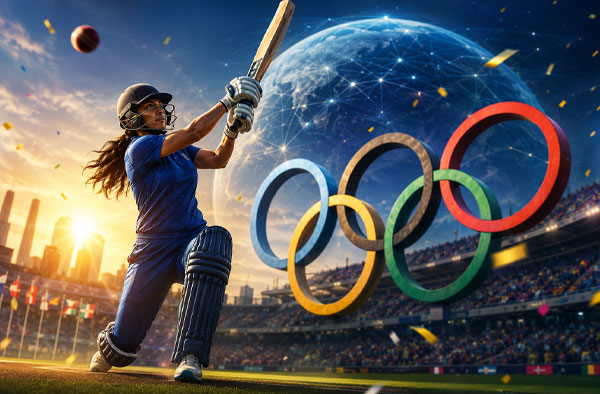
Cricket did not re-enter the Games by reclaiming its relevance in History, but by transforming itself into a format that lines up with Olympic restraints.
The transformation is evident across global digital sports networks, including analytical and staking environments used by platforms such as Raj.bet, where the shift of cricket towards short formats, presents data, and sectional competition made it indistinguishable from other Olympic-ready disciplines. Cricket’s return signifies structural inclusion rather than mere symbolic recognition.
Cricket Becomes an Olympic-Compatible Competition Unit
Cricket’s return proves that inclusion of Olympics now depends on whether a sport can function as a compact, repeatable competition unit confined in a coordinated multi-sport system, where time, space, and airtime are strictly limited, not negotiable.
Operational Signals Behind Inclusion:
- Match duration shortened to ~170–190 minutes, including innings break and changeover, positioning with standard Olympic sessions.
- Structures of Fixed Length (20 overs per side) that eliminate time volatility caused by slow play, weather, or extended innings
- Per match – 240 deliveries, creating expected pacing and uniform data/event density
- 2–3 matches per venue per day, depending on how fast the teams can switch over and what the lighting conditions are.
- Teams will have a standard 90-to-120-minute window to switch over, which fits perfectly within Olympic venue rules.
- Tournament windows are restricted to 7–10 days, aligning with Olympic discipline rotation.
- 8–12 participating teams, which allows a global picture without any bracket inflation
- 16–24 total matches each tournament, sufficient for medal resolution and clarity in ranking
- Single gold–silver–bronze pathway, avoiding the uncertainty of a multi-series
- Contingency rules, which are standardised, include reduced-overs formats (5–10 overs) to guarantee outcomes
Temporary or shared venue placement reduces the need for permanent, single-use infrastructure. Central scheduling authority, replacing two-sided flexibility with fixed Olympic control
These characteristics transpose cricket from a calendar-dominant sport into a controllable event module that can be simulated, planned, and enhanced in parallel to dozens of other Olympic sports.
Cricket vs Olympic Operating Logic
| Dimension | Pre-Olympic Cricket | Olympic-Compatible Cricket | Operational Effect |
| Match length | 7–40 hours | ~3 hours | Session compatibility |
| Time certainty | Variable | Fixed | Predictable
scheduling |
| Deliveries per match | Open-ended | 240 fixed | Uniform pacing |
| Venue utilization | 1 match/day | 2–3 matches/day | +100–200%
efficiency |
| Turnaround time | Unstandardized | 90–120 min | Venue rotation |
| Tournament span | Weeks/months | ≤10 days | Olympic fit |
| Event density | Low | High | Medal viability |
| Competition design | Series-based | Compact brackets | Ranking clarity |
| Contingency handling | Ad hoc | Predefined | Fewer disruptions |
| Infrastructure model | Dedicated grounds | Multi-use / temporary | Cost control |
| Scheduling authority | Bilateral | Centralized | Planning stability |
Cricket’s inclusion is part of a bigger shift for the Olympics. They are focusing more on sports that fit into tight schedules and reuse facilities, instead of those that require long tournaments and highly flexible formats.
Market Scale Redefines Olympic Value
Cricket’s Olympic return greatly changes how the Games expand audience reach and regional relevance in a split media environment.
- Global cricket audience estimated at 2.5–3.0 billion, exceeding the audience of most Olympic disciplines
- India alone represents ~1.4 billion potential viewers of the sport, the largest single-market growth pedal.
- ICC membership outstanding 100 nations, an increase in geographic legitimacy
- Asia–Middle East–UK–Australia–Africa corridor, that forms a continuous high-engagement time zone
- Consumption patterns like Digital-first, where short highlights outdo long live sittings
- Women’s cricket is sustaining double-digit annual audience growth, firming long-term relevance
- Year-round cricket calendars, allowing continuous engagement outside of Olympic cycles
- Franchise ecosystems with valuations mostly above $100M, which depicts commercial maturity.
This scale matters because the growth of the Olympics now depends on additional audiences rather than rearranging the existing ones.
Cricket does not substitute traditional Olympic sports; it rather expands the Games’ relevance into markets where attention, viewers, and digital interaction are already rooted.
Cricket Integrates Fully Into Olympic Systems
Cricket’s return also makes the fact evident that it now fits effortlessly into the Olympic technical and governance infrastructure, not requiring bespoke handling.
Modern cricket competitions operate within centralized data, integrity, and broadcast frameworks that mirror those used by established Olympic disciplines, allowing the sport to scale without exception.
- Ball-level data feeds back real-time scoreboards, analytics, and broadcast graphics
- Automated highlight generation produces the clips in less than 30-90 secs
- Constant integrity monitoring applies incongruity detection across all the matches
- Standardised officiating systems reduce subjective alteration
- Instead of multiple setups, a single data stream can power the broadcast, the analytics team, and the storage archives all at once.
A great example of this is how the ICC already runs major global tournaments. They capture ball-by-ball data in one central place and send it out instantly to TV broadcasters, umpires, anti-corruption teams, and stats platforms all at the same time.
Hawk-Eye Innovations enable real-time ball tracking, edge detection, and decision review, while integrity monitoring partners like Sportradar oversee continuous anomaly detection across betting and results data.
These systems already have a role at World Cup and T20 tournament scale, meaning Olympic incorporation requires no new technical layer, only enclosure into existing IOC pipelines.
System-Level Compatibility
| System Layer | Legacy Cricket | Olympic-Ready Cricket | Measured Outcome |
| Data granularity | Session-level | Ball-by-ball | 300–350 events/match |
| Data latency | Minutes | <1 second | Live integration |
| Integrity coverage | Partial | Continuous | 100% events |
| Broadcast format | Long-form | Modular clips | Slot-based delivery |
| Officiating tech | Variable | Standardized | <20s decisions |
| Venue dependence | Dedicated | Temporary/multi-use | Lower capex |
| Qualification logic | Fragmented | Predefined | Transparency |
Cricket is no longer an operational headache for the Olympics. It behaves like a modern, data-native sport, plugging smoothly into the existing Olympic network to power broadcasts, refereeing, and match results all at once.
Conclusion
Olympic return of Cricket means the Games are growing toward structure-driven insertion. Cropped-timing formats, huge global markets, and full system compatibility changed cricket from an outlier into an Olympic asset.
Its return isn’t just about bringing back history—it shows how much the rules have changed for how global sports earn a spot in the Olympics!

Loves all things female cricket