Australia head into the ICC Women’s ODI World Cup 2025 with a blend of proven stability and a willingness to embrace unfamiliar challenges. Led by skipper Alyssa Healy, the reigning champions arrive in India knowing that despite their depth and experience, conditions across the tournament’s mixed set of venues may test their adaptability.
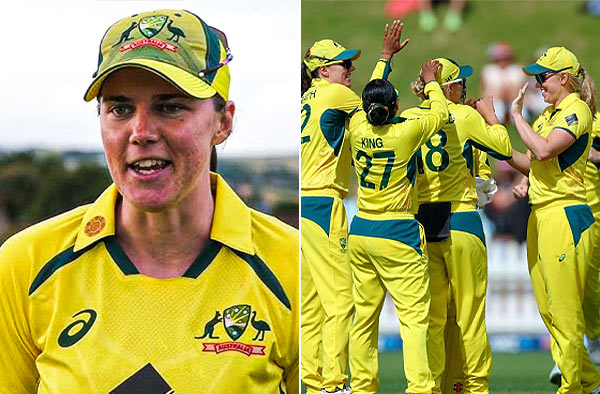
Vice-captain Tahlia McGrath has echoed that sentiment, describing the campaign as one where “a little bit of experience” will meet “a little bit of unknowns,” a mix Australia is eager to thrive on as they aim to defend their world title.
For many of Australia’s cricketers, India has become something of a second home thanks to frequent bilateral tours and major tournaments. Yet, even with that exposure, the World Cup presents a fresh landscape. Several venues, including Indore’s Holkar Cricket Stadium, Guwahati’s Barsapara Stadium, and Navi Mumbai, will host women’s ODIs for the first time, making every outing a step into the unfamiliar.
“No matter where you are in India, you can get thrown up very different conditions from day to day, so excited about the challenge,” McGrath noted ahead of the three-match series against India starting September 14 in New Chandigarh.
Adding another layer of unpredictability is Sri Lanka, the co-host nation. Colombo’s Premadasa Stadium, long a fortress for spin, hasn’t hosted Australia since 2016, when only a handful of the current squad toured. Head coach Shelley Nitschke has already leaned on Australia’s men’s team for tactical insights on the venue after it hosted a string of spin-heavy ODIs earlier this year.
Australia’s advantage lies in the continuity of their squad. McGrath expressed confidence in what she called a “settled” group, remarking, “We’ve been pretty lucky with that… we’ve got so much talent, so much depth over here that it doesn’t really matter what team we throw out or what batting order, we’re in pretty good hands.” With 15 players in the World Cup squad and a slightly extended group touring India, the bilateral series will double as a testing ground for combinations.
[embedpress]https://x.com/imfemalecricket/status/1966419236668256671?t=6COtzsiTKWeUH5ADdOK7mQ&s=19[/embedpress]
The selectors have also given younger faces exposure. The uncapped pair of Nicole Faltum and Charli Knott are in the mix, while left-arm spinner Sophie Molineux edges closer to full fitness after knee surgery. She is expected to be ready in time for the World Cup, though not for the India series.
Australia’s ODI class of 2025 carries more than just the weight of defending champions. Recent disappointment from the 2024 T20 World Cup semi-final defeat to South Africa lingers in the memory, sharpening their resolve. McGrath underlined this when she described ODI cricket as “probably the pinnacle,” and admitted the team had “that extra little bit of motivation” after a painful exit in the shorter format.
If successful, Healy’s Australia would become the first team since 1988 to defend the women’s ODI crown, another milestone within reach for a side already synonymous with dominance in world cricket. Their opening assignment looms large: a World Cup clash against Sophie Devine’s New Zealand at Indore on October 1 from 3 PM IST, a contest that will immediately test their appetite for both the expected and the unknown.
Before then, however, the three-match ODI series against India between September 14 and 20 offers the perfect tune-up. For Healy’s side, it will not just be a rehearsal but a baptism into new venues and conditions, exactly the type of challenge that could define their campaign. As McGrath summed it up: “It’s about learning the conditions, adapting to the conditions, being flexible and communicating really well as a group because it is a little bit foreign to us.”
Australia might be carrying an unmatched pedigree into the 13th edition of the tournament, but it is their ability to embrace uncertainty that could prove decisive in their chase for back-to-back glory.

Loves all things female cricket