Shabnim Ismail became the first bowler in ICC Women’s T20 World Cup history to reach 50 wickets during South Africa’s second semi-final against hosts England at The Oval on 2 July 2026, a fitting milestone for a 37-year-old veteran who reversed her international retirement to galvanise the Proteas’ pace attack.
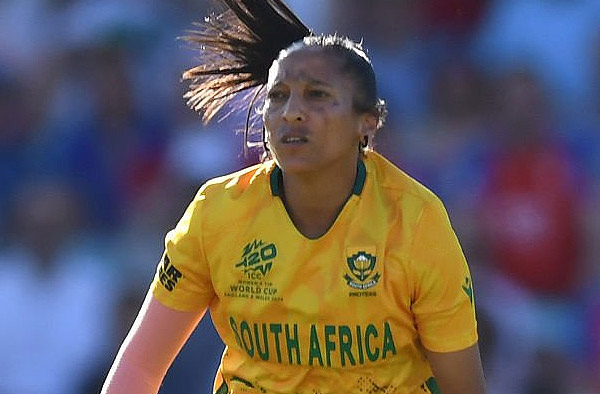
Shabnim Ismail, who had announced her international retirement on 3 May 2023 and then reversed it on on 12 May 2026 with a clear mission to help South Africa chase a maiden T20 World Cup title, needed one wicket going into the knockout clash and claimed two (Amy Jones and Alice Capsey) to move past the landmark in the tournament she has been part of since the inaugural edition in 2009.
The semi-final began with Laura Wolvaardt’s decision to field, and South Africa’s new-ball duo, Marizanne Kapp and Shabnim Ismail, immediately made life uncomfortable for England. Exceptional early strikes reduced the hosts to 35 for 3 in the powerplay, with Ismail and Kapp cutting out the top order and setting the tone.
England’s rescue came through experience: Heather Knight (58 off 47) and the returning Nat Sciver-Brunt (75 off 47) steadied the innings, shifting gears as conditions demanded and compiling a monumental 133-run partnership, the highest in a knockout match in the Women’s T20 World Cup’s history. England finished with a challenging 169 for 5.
Ismail returned figures of 4-0-31-2, removing Amy Jones and Alice Capsey, while Nonkululeko Mlaba (4-0-25-2) and Marizanne Kapp (4-0-16-1) also delivered controlled spells. Ismail’s milestone wicket, part of an enduring T20 World Cup legacy that began with her tournament debut on 11 June 2009, was both personal and historic: she now sits alone on 51 tournament wickets at an average of 15.86 and an economy of 6.01 in 38 innings (38 matches).
Across her international T20 career, she has 131 wickets in 119 matches at an average of 18.65 and an economy of 5.83, figures that underline longevity and sustained effectiveness.
The narrative of Ismail’s career reads like a manual for fast-bowling longevity. She first burst onto the international scene in an ODI in January 2007, and over nearly two decades she has combined raw pace, late swing and relentless accuracy. Her best T20I spell for South Africa remains the devastating 5 for 12 against Pakistan at Durban in January 2021, while her World Cup best was 3 for 5 against Ireland in Sylhet in 2014.
Returning from retirement in May 2026, Ismail’s brief but potent contributions in this edition, finishing as South Africa’s joint leading wicket-taker with eight scalps alongside her new-ball bowling partner Marizanne Kapp, vindicated her decision to come back and bolster a Proteas bowling line-up that has relied on her in pressure moments.
Chasing 170, South Africa struggled to climb the steep target and were eventually restricted to 129 for 8. Ismail chipped in with an unbeaten 2 at number 10 as the chase fizzled, but the better story of the night remained England’s ability to recover from early blows and the landmark individual achievement of the visiting spearhead. For Ismail, the milestone is bittersweet: it cements a place in T20 World Cup history but came in a semi-final defeat that denied South Africa their 3rd consecutive final appearance in the tournament.
South Africa’s road to the semis in this 10th edition, hosted by England and Wales from 12 June to 5 July 2026, was far from straightforward. Placed in a tough Group A with Australia and India among others, the Proteas lost their opener to Sophie Molineux’s Australia by 65 runs at Manchester on 13 June but then strung together four consecutive wins: tight victories over Pakistan and India, a comprehensive win over the Netherlands and another against Bangladesh at Lord’s. That run, and Australia’s later victory over India, were decisive in South Africa clinching fourth place to reach the knockout stage.
Symbolically, Ismail’s achievement resonates beyond a single match. Playing her ninth World Cup campaign, she has been the tournament’s most successful bowler across editions, and her return from retirement injected both experience and aggression into South Africa’s attack. While the Proteas fell short of a final berth, Ismail’s record and her role in pushing South Africa deep into the tournament reinforce her status as one of women’s cricket’s great fast-bowling custodians.
At 37, with 51 T20 World Cup wickets and 131 international T20 scalps to her name, Shabnim Ismail’s milestone is a reminder that class, timing and fierce pace can keep a bowler relevant long after many peers have moved on.

Loves all things female cricket