At 28, Deepti Sharma has stepped into a space once reserved for legends, becoming the leading wicket-taker in Women’s International Cricket with 356 wickets in 278 innings, nudging past the towering figure of India’s Jhulan Goswami, who finished with 355 wickets in 291 innings.
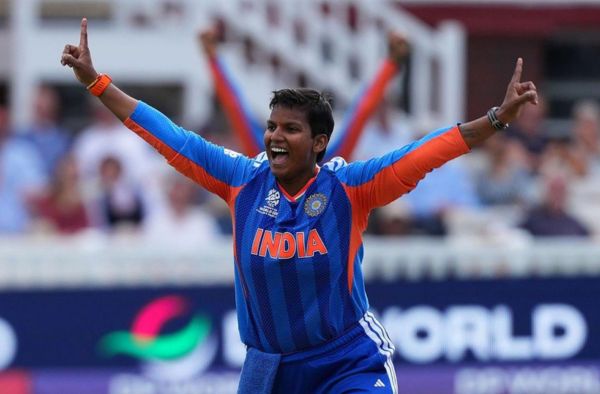
On a grey yet grand evening at Lord’s on 28 June 2026, in India’s must-win clash against Australia in the final league game of the 10th ICC Women’s T20 World Cup, the off-spinning all-rounder claimed the wicket she needed, Beth Mooney, to etch her name atop a record that has long defined excellence in Indian women’s cricket.
This milestone, achieved in a campaign that ultimately ended in heartbreak for India, encapsulates the essence of Deepti’s career: relentless consistency, quiet steel, and a knack for making her presence felt across formats and phases of the game.
Harmanpreet Kaur’s decision to bat first in this virtual quarterfinal set the tone for a high-stakes evening at the iconic venue. India’s 170 for 4 was built on a measured yet impactful top-order effort and a blazing finish from the skipper. Smriti Mandhana anchored with 38 off 37, while Shafali Verma’s 34 off 26 kept the powerplay tempo alive. Jemimah Rodrigues, who retired out in the 19th over after a steady 34 off 28, allowed India to recalibrate for a final surge. Harmanpreet, unleashing her big-hitting range, smashed three consecutive sixes in the final over, en route to hammering 56 off just 27 balls, registering her third T20 World Cup fifty against Australia and propelling India to a competitive total of 170.
The left-handed batter, Deepti, came in at number 6, found time only for a solitary boundary off the final ball, but that strike underlined her growing confidence as a finisher in tight death-overs scenarios. Defending 171, India needed their senior bowlers to attack and contain in equal measure, and Deepti responded with characteristic discipline, returning figures of 4-0-31-1. Her landmark moment arrived when she dismissed Beth Mooney for 22 off 20 balls, in the 10th over, a wicket that briefly tilted the game’s mood as much as it shifted the record books.
Yet Australia’s chase, powered by the experience and composure of Ellyse Perry (56 off 38) and the aggression of Ashleigh Gardner (an unbeaten 53 off 29), closed out with an over to spare and six wickets in hand, keeping their league stage record spotless and knocking India out of the tournament. The result simultaneously opened the door for Laura Wolvaardt’s South Africa, who sneaked into the semi-finals courtesy of Australia’s win, underscoring how Deepti Sharma’s personal milestone unfolded in a wider narrative of group-stage permutations and an eventual heartbreak.
Across the campaign, Deepti’s numbers told the story of an all-rounder at the height of her powers. With the bat, she amassed 60 runs in five innings at a striking rate of 171.42, often injecting late-overs momentum in pressure situations. With the ball, she collected 7 wickets in five matches at an average of 19.14 and an economy rate of 7.05, providing India with control in the middle overs and breakthroughs when the game drifted.
India’s campaign, however, ended in Group A as a third-placed side with three wins and two losses, finishing with six points and a lingering sense of what might have been. Amid the disappointment, Deepti’s all-round contribution and the historic wicket tally offered a powerful counterpoint: even in collective failure, individual excellence can redefine the legacy of a team’s era.
T20I Pillar: World Cup Consistency and Peak Performance
The 2026 T20 World Cup marked Deepti’s fifth appearance in the tournament, stretching back to her debut campaign in 2018 and underscoring her longevity in the shortest format. Over 24 matches and 19 innings with the bat in this competition, she has compiled 278 runs at an average of 27.8 and a strike rate of 106.51, a profile that reflects her evolution from lower-order stabiliser to flexible middle-order option. With the ball, she has claimed 26 wickets at an average of 24.26 and an economy of 6.94, including a five-wicket haul, making her the second-highest wicket-taker for India in Women’s T20 World Cup history, behind only former leg-spinner Poonam Yadav.
Her T20I career more broadly has been a testament to sustained impact since debuting against Australia at Sydney on 31 January 2016. She has collected 168 wickets in 149 matches, across 146 innings, at an average of 19.93 and an economy rate of 6.35, including one four-wicket haul and two five-wicket hauls. Her remarkable returns, making her the leading wicket-taker in the T20I format.
The standout came in this very World Cup, on 14 June 2026 at Edgbaston against arch-rivals Pakistan, where she produced a spell for the ages with figures of 4-0-10-5. Three of those wickets came in a dramatic final over of her spell, as she wrapped up Pakistan’s chase in the 17th over, redefining the ceiling for Indian bowling performances in T20 World Cups. That spell not only earned her the Player of the Match award but also surpassed Renuka Singh’s 5 for 15 against England in 2023 as the best figures by an Indian bowler in the competition’s history, firmly situating Deepti’s T20I legacy among the format’s elite.
ODI Backbone: Crafting Control And Breakthroughs
Deepti’s ascent to the summit of international wicket-taking owes much to her ODI body of work, which began on 28 November 2014 against South Africa in Bengaluru. In the years since, she has been the ballast of India’s ODI attack, combining subtle off-spin with unerring control and a deep understanding of match situations.
Across 123 innings in the format, she is India’s 2nd highest wicket-taker as she has picked up 166 wickets at an average of 27.69 and an economy of 4.45, numbers that highlight her ability to operate both as an attacking option and a run-choking workhorse. Her haul includes three four-wicket returns, two five-wicket hauls, and a pair of six-wicket specials, proof of her match-winning ceiling on surfaces that reward discipline more than mystery.
The defining performance of her ODI career arrived on 19 February 2016 in Ranchi against Sri Lanka, when she produced breathtaking figures of 9.2-1-20-6. India cruised to a seven-wicket victory, and Deepti’s all-round influence naturally earned her the Player of the Match award, underscoring her capacity to dominate in conditions where the margin for error is slim. That spell has remained a touchstone for her ODI career.
Test Craft: Patience, Precision, And Long-Form Dominance
If T20Is and ODIs have showcased Deepti’s adaptability, Test cricket has revealed the depth of her bowling craft. Since making her debut against England at Bristol on 16 June 2021, she has developed into a vital cog in India’s evolving red-ball structure. In nine innings, she has taken 22 wickets at an outstanding average of 19.50 and an economy rate of just 2.37, numbers that speak to her ability to sustain pressure over long spells while still hunting for dismissals. A four-wicket haul and a five-wicket haul already adorn her Test resume, reflecting a bowler who can both chip away and run through line-ups over the course of a match.
Her finest Test outing came at the DY Patil Stadium in Navi Mumbai on 14 December 2023, again against England, where she produced career-best match figures of 13.3-6-39-9 across both innings. In a contest India dominated to secure a 347-run victory, Deepti’s spell embodied everything that makes her unique: relentless accuracy, subtlety off the surface, and the temperament to exploit even the slightest mistake in defence. The Player of the Match award from that Test added another chapter to her growing reputation as a genuine multi-format match-winner, reinforcing that her value to India extends far beyond any single format or role.
As Deepti Sharma stands above all others in the women’s international wicket charts, the symbolism of surpassing Jhulan Goswami cannot be ignored. Where Jhulan embodied pace, Deepti represents guile; where one smashed through with new-ball aggression, the other strangles with off-spin control and all-round flexibility. Together, they bookend an era of Indian women’s cricket in which bowlers have not merely supported but often defined the team’s identity. Deepti’s story, still very much in progress at just 28, is now written into history’s top line, and yet, the sense persists that her most compelling chapters may still lie ahead.

Loves all things female cricket