The dominant Australian team is now in an unexpected position: fighting to hold their all-conquering, dominant image, as the gap in women’s international cricket closes. Entering a major event without an ICC trophy is a startling reality for a team used to having a cabinet full of awards. However, there is a sense of shared hunger rather than fear in the camp as the ICC Women’s T20 World Cup 2026 in England and Wales draws near. Phoebe Litchfield, a 23-year-old left-hander, is at the center of this comeback. She is prepared to go from being a teenage prodigy with an incredible switch-hit to a profitable match-winner at the top level.
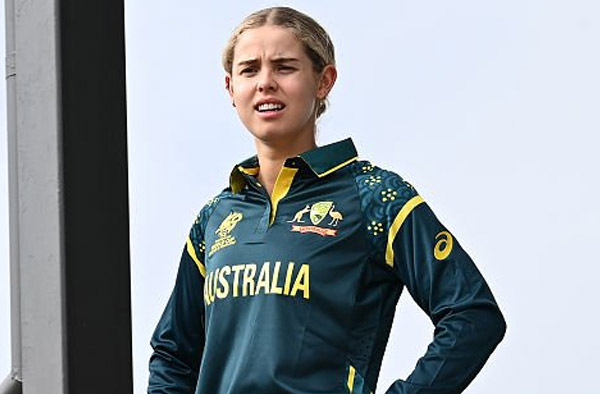
Litchfield sees the competition as a fresh start and an opportunity to turn over her recent personal situation in the quickest possible way. Although she demonstrated her potential with an incredible 119 against India in the 50-over World Cup semi-final last year, it has proven difficult to apply that level of performance in T20 Internationals (T20Is). She has only managed a top score of 35 in 12 innings since the 2024 World Cup, a statistical aberration that she is actively trying to correct by consulting the team’s top players.
“I have been speaking to Moon (Beth Mooney), speaking to Midge (Alyssa Healy) and even Pez (Ellyse Perry) about how they go about it,” Litchfield revealed, acknowledging the steep learning curve. “Last T20 World Cup, I was a bit further down the order, and T20I cricket is tough sometimes, especially when you’re starting. Learn a few tricks there and also just to know how to put an innings together in the T20 format. It’s a bit of a different art to the 50-over, so I am trying to learn on the go and I am really excited for the challenge.”
Mastering a function that requires quick impact rather than gradual buildup is part of that challenge. Although Litchfield is a natural starter in the lengthier format, she has given up that inclination in order to secure the crucial number three spot, placing herself behind a strong opening duo. She embraces the job, in large part because of the powerful depth that surrounds her. “I actually really enjoy it,” Litchfield said of her role one step down the order. “I’d love to open, but it’s pretty hard to get Moon stepping away. I’ve done it in the Big Bash, done it for the WPL and done it in The Hundred. I should be better than what my stats say for Australia, but I love the challenge and love that Shell (Shelley Nitschke, head coach) has entrusted me with that role.”
That tactical flexibility will be tested more than ever following the monumental retirement of former captain and long-time opening mainstay Alyssa Healy earlier this year. Healy’s absence leaves a void not just in runs, but in the psychological intimidation factor at the top of the order. Litchfield admits there is an underlying pressure on the current top three but believes the team has already begun adapting to life after their talismanic keeper-batter. “There’s a little bit of pressure, but also we’ve played a few games, and I think she must have been injured in a couple of those Ashes games as well,” Litchfield recalled. “We will miss her, but I think we’ve had a few practices now without the fireworks up at the top of the order so we’re getting used to it. It is a bit weird not seeing her behind the stumps and slashing balls over cover, but our team has adapted well.”
The motivation for this Australian squad runs deeper than just moving past a transition phase; it is fueled by the lingering sting of their premature exit at the previous T20 World Cup in Dubai. Falling to South Africa in the semi-finals exposed rare cracks in the Australian armor, proving that matches can slip away in the space of a few mistimed overs. To avoid a repeat of that heartbreak on English soil, Litchfield emphasizes the need for an uncompromising mindset when the pressure peaks. “I think it’s just winning the big moments,” she noted. “I feel like we do a lot right and most of the time it’s 18 out of the 20 overs. So, it’s probably just those moments where the game is in the balance—is taking it and being a bit more ruthless and remembering why we are so good and using that in everything we do.”
This renewed ruthlessness will be essential in a tournament that looks entirely unpredictable. While Indian captain Harmanpreet Kaur recently backed her side as the definitive favorites on the heels of their 50-over World Cup triumph last year, Litchfield views the grid as far more egalitarian. She points to New Zealand’s stunning, dark-horse victory in 2024 as definitive proof that the traditional hierarchies in the women’s game have collapsed. “Heading into this World Cup I don’t think there’s a favorite, there’s favorites,” Litchfield explained. “The term favorite is actually quite hard to pick these days. I’d love to say Australia and I will say Australia. But yeah, as a fan of women’s cricket, I think you saw that New Zealand won the last one. So, you can’t really pick a favorite these days.”
In the end, Litchfield’s excitement as June 12 draws near is precisely what is fueling the competition’s open character. Although there is tremendous pressure to bring Australia back to the top of the international cricket rankings, the possibility of winning her maiden ICC trophy in front of fervent supporters in Wales and England is alluring. She wants to find her form on the great stage since she is a batter with a natural flare and aggression. “Every major tournament’s a real priority for our group and there’s a lot of excitement with a world fixture,” Litchfield said, her focus firmly locked on the prize. “You just got to take the ball, take the game by the scruff of the neck and run with it.”
(Quotes sourced from ICC)

Loves all things female cricket