India’s deaf women’s cricket team will make history with their first-ever international T20 tour, heading to Sri Lanka for a five-match T20I series from July 7–13, 2026, at De Soysa Park International Cricket Stadium in Moratuwa.
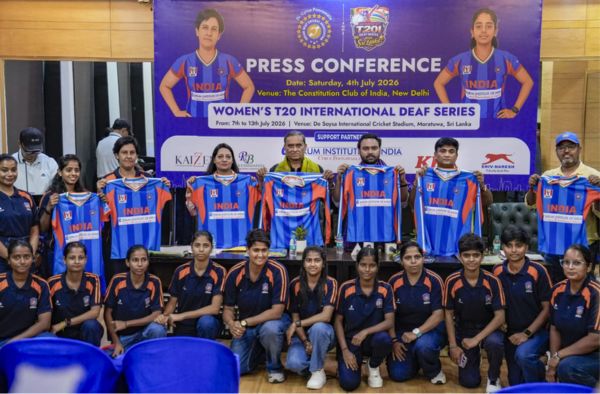
The 15-member side, led by wicketkeeper-captain Kajal Dhawan with Needa Zabi Shaikh as vice-captain, carries the hopes of a growing movement that insists cricket truly belongs to everyone.
India Squad:
Kajal Dhawan (C, WK), Needa Zabi Shaikh (VC), Pratima Mishra (WK), Aakansha Kanasiya, Reddy Jyoshna, Dipti Rani Sahoo, Shraddha Vaishnav, Sangeetha, Sukanya K. S., Ruby Yadav, Chandani Khan, Priyanshi Dixit, D. Kanthamma, Priyanka Saini, Anjali
The matches will give the team its first taste of international competition and an important platform to showcase the standards they have reached domestically and in deaf-cricket events.
The timing of the announcement carries a symbolic charge: it comes as the global women’s game celebrates another high point, the final of the 10th ICC Women’s T20 World Cup 2026 at Lord’s. In a narrative that underlines the sport’s expanding reach, hosts England (skippered by Nat Sciver-Brunt) and six-time champions Australia (led by Sophie Molineux) are contesting the final after remaining the only unbeaten sides in the tournament, an elite stage that reflects how women’s cricket continues to deepen its competitive and cultural footprint. While the World Cup unfolds on cricket’s most hallowed turf, India’s deaf team will be writing a pioneering chapter of their own in Moratuwa.
Former India captain Diana Edulji hailed the tour as a landmark moment. “It is a significant milestone for India that our hearing-impaired girls have got their first international call-up. Cricket belongs to everyone!” she said, praising the players’ calibre and sportsmanship after watching them play in Mumbai’s T10 deaf tournament. Her words framed the tour as recognition not only of talent but of perseverance and access.
Skipper Kajal Dhawan captured that sentiment perfectly. “Going to Sri Lanka for our first international T20 tour is not just about playing cricket; it’s about proving that hearing is not a barrier to passion, skill, or representing our country. Every player in this team has worked tirelessly, and we will be carrying the hopes of every girl in India who dreams of wearing the blue jersey.” That message will resonate across the squad as they prepare for five consecutive T20Is in a compact window that will test depth, strategy and adaptability.
Looking beyond July, the Indian Deaf Cricket Association has signalled sustained ambition. It confirmed a T20I Tri-Series in India in March next year featuring Sri Lanka and Trinidad & Tobago, and announced the DICC Women’s T20 World Cup set for Delhi in February 2028. Those plans indicate a roadmap designed to build international exposure, competitive continuity and visibility for deaf women’s cricket.
This Moratuwa tour is therefore more than five matches; it is the opening act of an international journey. On cricketing terms, it will be a moment for players to measure themselves under pressure and for selectors and stakeholders to evaluate the pipelines feeding disability cricket. On cultural terms, it is a public affirmation that the sport’s global growth must be inclusive, and that the game’s next milestones will be claimed by those who have long waited for a larger stage.

Loves all things female cricket