Sushma Verma’s 237 in the Inter-Zonal Multi-Day Trophy Final 2026 in Puducherry will be remembered not just for its scale, but for the story it carried within it a story of reinvention, regret, and remarkable resolve. Opening the innings for North Zone for the first time in red-ball cricket, the 33-year-old wicketkeeper-batter produced a marathon 237 off 498 balls, striking 30 fours and four sixes. It was the second-highest individual score in women’s first-class cricket, falling just five runs short of Kiran Baluch’s world record 242 set in 2004.
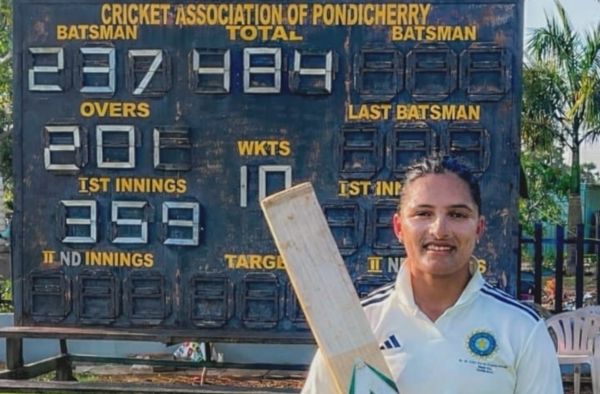
This was only Sushma’s 11th first-class match. Her previous highest score had been just 75 not out. Yet, on this occasion, she stood at the center of a defining performance. West Zone had posted 359, and in response, North Zone rode on her innings to reach 484, securing a decisive 125-run first-innings lead. When the match ended in a draw, that lead ensured North Zone were crowned champions.
The circumstances leading into the innings made it even more compelling. Sushma was not originally meant to open; she had prepared to bat at No. 3. But an injury to Priya Punia forced a late reshuffle, and she stepped up without hesitation. Reflecting on how her role evolved, she said, “The plan was, I would bat one down. In our first match, against North-East Zone, I came in at No. 6 and had to shepherd the tail. I think our coach, Dipti Dhyani di, realised I could be more useful up the order.”
Her innings began cautiously against the new ball, facing bowlers like Sayali Satghare and Saima Thakor. Adjusting to conditions on a 1.5-day-old pitch, she took time to settle. Her first 100 came off 285 balls, built on patience and survival. But once set, she shifted gears significantly—her second hundred coming off just 159 balls, with 74 runs in boundaries. She anchored a 231-run partnership for the second wicket with Ayushi Soni, who made 109, before adding 68 runs with Priya Punia (10 off 84 balls) and 82 runs with Shweta Sehrawat (18 off 108 balls), often carrying the scoring burden herself.
As the innings progressed, her confidence surged. By the end of day three, she was unbeaten on 212, having already surpassed Mithali Raj’s 210 not out, the highest score in Indian domestic cricket and then 214, Raj’s highest in women’s first-class cricket. Yet, Sushma remained focused not on records but on her rhythm at the crease. She later reflected on that growing belief, saying, “The first 50 runs surprised me, in a good way, that I was guiding the team despite opening for the first time. After that, there was no nervousness. At the end of the second day, when I was on 65 not out, I spoke to my coach, Pawan Sen. He said I must score a hundred. I told him not just a hundred, I could sense a double-hundred.”
Despite a few moments of luck—missed chances before she reached her hundred, she capitalized fully. But the ending carried a hint of heartbreak. With the world record of 242 within reach, she was dismissed for 237 by Saima Thakor. Reflecting on that moment, she admitted, “In the whole innings, I lost focus on only two balls: the one I got out on and the one just before that. By then, the second new ball was 60-odd overs old and they had seven fielders on the boundary, so run-scoring wasn’t easy. When I came to know how close I was to the world record, I was very disappointed.”
To understand the weight of this innings, one must look back at Sushma’s journey with the Indian team. She was once a regular presence, but her career took a painful turn during the 2017 ODI World Cup final at Lord’s. Chasing 229 against England, India were 191 for 4 when she arrived at the crease, only to be dismissed for a two-ball duck attempting a sweep shot. India lost by nine runs, and the moment haunted her deeply. Speaking about its impact, she said, “I felt we lost the World Cup because of me. For the next two years, I didn’t play a single sweep. Till this day, I have not watched the highlights of the final – I am scared it might traumatise me all over again.”
The years that followed were marked by inconsistency in opportunities. She was dropped, made brief comebacks, and last played for India in 2021. In the 2023 T20I tri-series in South Africa, she did not get a game. Her stint in the Women’s Premier League was modest—42 runs in five innings at a strike rate of 79.24. Yet, she persisted. She balanced playing with commentary, sharpened her understanding of the game, and made a conscious decision to step away from broadcasting to focus fully on cricket.
That decision bore fruit. In the domestic one-day tournament preceding this innings, she scored 344 runs in six innings at an average of 344.00 and a strike rate of 87.53, including nine sixes—evidence of a more confident, aggressive approach.
In the quiet of a ground with no photographers to capture the moment, Sushma Verma produced an innings for the ages, one that not only rewrote record books but also redefined her own journey.
(Quotes sourced from ESPN Cricinfo)

Loves all things female cricket