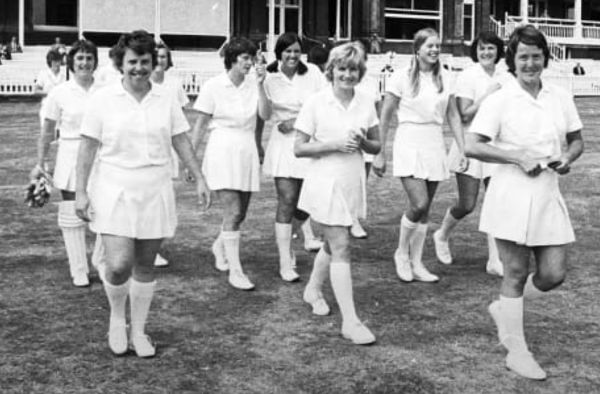
On this day, 50 years ago, on 4 August 1976, the sport’s most storied address, Lord’s Cricket Ground, opened its gates to women’s international cricket for the very first time, as England and Australia met in a historic 60-over ODI that would quietly reshape the game’s relationship with the Home of Cricket.
Five decades later, the same turf has just witnessed the first-ever women’s Test at Lord’s, where Harmanpreet Kaur’s India dismantled Nat Sciver-Brunt’s England by a record 270 runs, only days after England had fallen to Sophie Molineux’s Australia in the ICC Women’s T20 World Cup 2026 final at the same venue. The arc from 1976 to 2026 is not just about fixtures; it is about space, recognition, and the slow, stubborn march of women’s cricket into the game’s most hallowed rooms.
Back in 1976, the second ODI of a three-match series between England, led by the indomitable Rachael Heyhoe-Flint, and Anne Gordon’s Australia carried significance far beyond the series scoreline. ODIs were 60 overs a side in that era, and the very fact that a women’s international had been scheduled at Lord’s, a venue that had long symbolised exclusivity, was itself a statement of intent and a victory for the trailblazers who had fought for visibility and respect.
Racheal Heyhoe-Flint had been at the forefront of those efforts, lobbying tirelessly for women to be allowed onto this stage, and the players knew they were walking into something that would outlive the day’s result.
Australia, having won the toss, chose to bat first, looking to post something substantial in these longer-format ODIs. Their innings never quite settled into dominance, but it was stitched together by pockets of resistance: Margaret Jennings’ 18 provided early stability, while Sharon Tredrea, who would go on to become one of the era’s most respected all-rounders, anchored the innings with a fine 54. Wendy Hills and Marie Cornish chipped in with 27 each, and it was the 71-run stand for the sixth wicket between Hills and Tredrea that gave Australia’s total its spine, lifting them towards a competitive score of 161, even as wickets fell around them.
England’s bowling attack, though, refused to let the occasion overwhelm the discipline of their craft. Enid Bakewell, already a legend in the making, delivered a characteristically controlled spell of 12 overs, taking 2 for 30 and applying the kind of pressure that rarely makes headlines but wins matches.
Jan Allen matched her impact with figures of 2 for 28 from 9 overs, while Glynis Hullah’s 1 for 23 in 11 tidy overs further strangled Australia’s scoring options. June Stephenson chipped in with 1 for 27 in 10.4 overs, and although Jacqueline Court and Lynne Thomas did not reap rich rewards in the wickets column, their combined economy ensured Australia were bowled out for 161 with a couple of balls unused, a total that felt more on par than imposing on that stage.
Chasing 162, England produced the kind of composed, professional batting display that felt perfectly in step with the significance of the day. Bakewell’s influence extended from ball to bat as she crafted a measured 50, while her opening partner Lynne Thomas contributed a vital 30, the pair adding 85 for the first wicket to deflate Australia’s hopes early in the chase. Even when the openers departed, England’s grip on the game never really loosened, as skipper Heyhoe-Flint’s 17 anchored one end and Chris Watmough’s unbeaten 50 provided the finishing flourish in an unbroken 70-run stand for the third wicket that sealed an eight-wicket win with 22 balls to spare.
For Australia, there were still positives buried within the defeat. Sharon Tredrea backed up her half-century with a miserly spell of 12 overs for just 23 runs, underlining her all-round class, while Karen Price’s 10 overs for 26 runs added further discipline with the ball. Patsy May, with figures of 1 for 24 off 12 overs, was the only wicket-taker, a reminder that on this particular day, the gulf lay more in execution than in effort. Yet, beyond the scorecard, what mattered most was that both sides had inscribed women’s cricket into Lord’s history, an inscription that future generations would deepen.
Fast-forward to July 2026, and the echoes of that first women’s ODI at Lord’s are impossible to ignore. England, still standard-bearers of the game, reached the ICC Women’s T20 World Cup final at home under Nat Sciver-Brunt, only to fall by seven wickets to Sophie Molineux’s Australia at the same ground on 5 July. Days later, that disappointment was followed by another landmark: the first women’s Test ever played at Lord’s, where Harmanpreet Kaur’s India stunned England with a record 270-run victory in a one-off Test from 10 to 13 July.
Those 2026 fixtures, layered with emotion and history, owe a quiet debt to 4 August 1976, when Heyhoe-Flint, Bakewell, Gordon, Tredrea and their contemporaries walked out onto a stage many believed would never be theirs. On this day at Lord’s, the scoreboard told a story of England’s eight-wicket win in a 60-over ODI; in the longer view, it marked the moment women’s international cricket stepped, irreversibly, into the heart of the Home of Cricket.

Loves all things female cricket