In a heartfelt conversation on The Great Indian Cricket Show on Doordarshan, former India all-rounder and commentator Reema Malhotra looked back at how Harmanpreet Kaur’s arrival changed the face of Indian women’s cricket. From her confident debut in 2009 to that unforgettable 171* against Australia in the 2017 World Cup semi-final, Malhotra described Harmanpreet’s journey as the spark that lit a revolution.
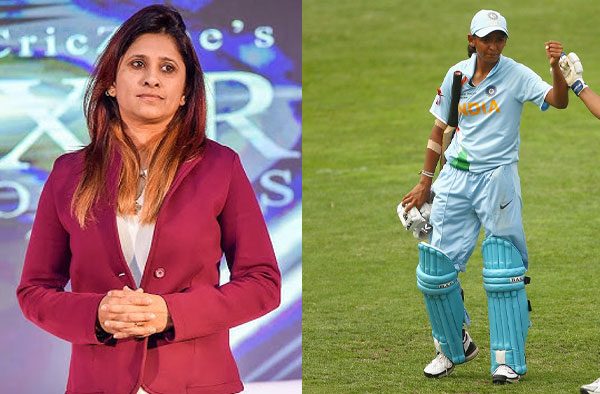
In the 2009 Women’s World Cup, Harmanpreet Kaur hit a stunning six off Ellyse Perry of Australia in Match 13 of the Super Six stage. The six came on the 47.5th ball of the innings and was a massive and memorable strike, marking her arrival as a fearless batter who could take on top bowlers with power. This moment especially stood out because India’s women’s team at the time lacked big hitters like those of Australia and New Zealand.
“When Harmanpreet Kaur made her debut in the 2009 World Cup, we saw her hit a six for the first time. We were looking for players who could hit those big, powerful shots. There were such players in teams like New Zealand and Australia, but we didn’t have one back then,” Malhotra recalled with pride.
Harmanpreet’s six against Perry was not only a statement of her ability to hit big shots but also a precursor to her transformative impact in women’s cricket, including her legendary 171* in the 2017 World Cup semi-final. This six was one of the early signs that she would bring a new aggressive vibe to Indian women’s cricket.
According to Malhotra, that one boundary symbolized a shift in mindset. “Harmanpreet brought a vibe, that yes, we are Indian players, but we can also hit big shots. She started with a six, but that six was heard till 2017, when she scored 171* in the World Cup semi-final. Such moments are rare, and that one changed everything.”
In the 2017 ICC Women’s World Cup semi-final between India Women and Australia Women held at the County Ground in Derby, Harmanpreet Kaur delivered a legendary innings that profoundly changed the perception of Indian women’s cricket. India batted first and initially found themselves in trouble with early wickets including Smriti Mandhana (6) and Punam Raut (14) falling quickly, reducing them to 35/2. Harmanpreet then took center stage, joining Mithali Raj and playing a match-defining knock.
Harmanpreet scored an unbeaten 171 runs off just 115 balls, hitting 20 fours and 7 sixes in an explosive yet controlled display of power hitting. This innings was likened to Kapil Dev’s famous 175 against Zimbabwe in 1983 in terms of rescuing the team from a precarious position while fighting against a strong Australian bowling attack.
Her 171* was the highest score in a Women’s World Cup semi-final and stood as a monumental landmark moment that energized Indian women’s cricket with a new confidence to hit big shots and dominate. This innings essentially put India on the path to victory, as the team posted 281/4 in a rain-reduced 42-over innings.
The Indian bowlers then successfully defended this total by restricting Australia to 245 all-out, sealing a memorable 36-run win for India and a historic berth in the World Cup final. Harmanpreet’s aggressive and fearless innings was pivotal in this win and changed the game for India, heralding a new era where Indian women could assert themselves with big-hitting prowess against the dominant Australian side.
That innings in Derby, where she dismantled the Australian attack with fearless strokeplay, became one of the defining moments in Indian sporting history. Malhotra believes it will stand alongside the most iconic knocks the game has ever seen.
“When we talk about men’s cricket, we always recall Kapil Dev’s 175—it transcends generations. I think Harmanpreet’s 171 will be that story for women’s cricket. That’s where the change began, in our thinking, our confidence, and our belief that women’s cricket truly existed at the world stage.”
The transformation that followed was unmistakable. India’s run to the final in 2017 captivated the nation and brought women’s cricket into the mainstream conversation. “After 2017, when we returned home as runners-up, there was noise, recognition, and pride. People started talking about women’s cricket. And it was all because of Harmanpreet Kaur,” Malhotra concluded.
More than just numbers on a scorecard, Harmanpreet’s innings continues to echo as a statement of courage and belief—and a reminder that one performance can alter the course of a sport.

Loves all things female cricket