The partnership between Smriti Mandhana and Shafali Verma in the final of the 2025 Women’s ODI World Cup will be remembered as a landmark moment in Indian cricket history. On a rain-hit evening in Mumbai, when conditions were expected to favor the South African pacers, the Indian openers walked out with calm assurance and a plan that redefined the opening approach in World Cup knockout games.
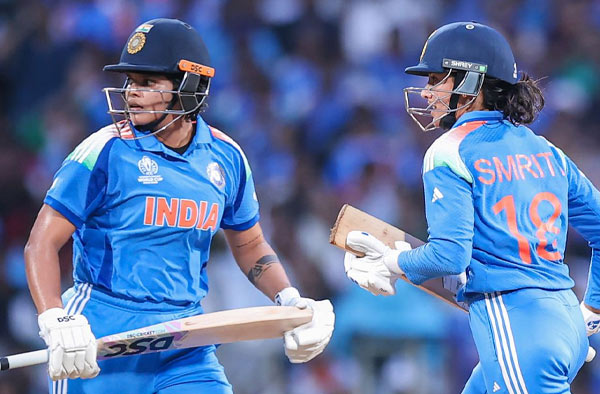
Facing the new ball under overcast skies is never easy, but Smriti and Shafali combined classical technique with aggressive intent to give India the perfect start. Their 104-run partnership in just 17.4 overs not only laid a strong foundation for India’s competitive total of 298/7 but also etched their names in the record books as the highest opening stand by any Indian pair, men or women in a World Cup knockout match.
Smriti’s elegance at one end perfectly complemented Shafali’s fearless stroke play at the other. Mandhana’s 45 off 58 balls was a calculated innings filled with drives and flicks that pierced the gaps with surgical precision, while Shafali’s 87 from 78 balls was pure dominance, a mixture of power and timing that left the South African bowlers scrabbling for answers.
From the very first over, the intent was clear; India was not going to be pushed on the back foot. As the partnership grew, so did the belief in the Indian camp, and by the tenth over, both batters had assured that early movement of the ball was neutralized. They rotated strike beautifully, capitalized on loose deliveries, and punished anything marginally off target. The chemistry between the two—one dominating through placement, the other through brute force—was the perfect blend of aggression and patience.
[embedpress]https://x.com/imfemalecricket/status/1984963893693931691?t=mCszbAtckD3tBRIGmJih7w&s=19[/embedpress]
The significance of this stand goes beyond just numbers. For the first time in the history of Indian cricket—across both men’s and women’s World Cups, a pair of openers crossed the 100-run mark in a knockout stage. Previously, India’s best in this context belonged to Navjot Singh Sidhu and Sachin Tendulkar, who added 90 runs in the 1996 Men’s World Cup quarterfinal against Pakistan.
Mandhana and Verma not only surpassed that mark but did so in a World Cup final, when the pressure was tenfold. The previous best for India Women in any World Cup knockout had been a modest 20 by S Harikrishna and Purnima Rau—a stat that underscores how revolutionary this achievement truly is. In less than 18 overs, Smriti and Shafali transformed that history of cautious starts into one defined by confidence and control.
What makes this partnership even more special is the unexpected nature of its formation. Shafali Verma was not part of India’s original first-choice lineup at the beginning of the World Cup. Pratika Rawal was slated to open with Smriti throughout the tournament, but her unfortunate ankle injury during the last game against Bangladesh opened a sudden vacancy at the top of the order.
Shafali, stepping in as a replacement, had a quiet outing in the semifinal against Australia, which led many to question whether she still had the spark that once made her one of the most promising young talents in the world. But champions rise on big nights and Shafali did just that. Backed by Mandhana’s calm leadership and precise shot selection, the youngster settled quickly, finding her rhythm to neutralize the South African attack with a mature yet aggressive approach rarely seen in players her age.
In many ways, this partnership was the defining factor of India’s innings. By the time Mandhana fell for 45, India had already crossed the 100-mark inside 18 overs, putting immense pressure on the South African bowlers and allowing the middle order to play with freedom. Jemimah Rodrigues, Deepti Sharma, and Richa Ghosh later capitalized on that start, ensuring India posted a challenging total close to 300, a target that carried immense scoreboard pressure in a World Cup final scenario.
[embedpress]https://x.com/imfemalecricket/status/1984965669616804139?t=mCszbAtckD3tBRIGmJih7w&s=19[/embedpress]
For Smriti and Shafali, though, the job was not merely about runs; it was about setting a tone. They played fearless cricket, shoulder to shoulder, underlining what modern Indian women’s cricket stands for aggression backed with composure, and belief matched with skill. The crowd at DY Patil Stadium knew they were witnessing something special. Every boundary from Smriti drew elegant applause; every lofted stroke from Shafali drew roars of exhilaration.
The 104-run stand will forever remain more than just a statistical highlight. It embodies the story of adaptability, trust, and audacious cricket played on the grandest stage. Against all odds, Smriti Mandhana and Shafali Verma turned a tricky situation into a statement of dominance. For those who witnessed it, it wasn’t just about milestones, it was about witnessing two generations of Indian batting come together in perfect harmony to script history.

Loves all things female cricket