India’s batting lineup has displayed concerning weaknesses in recent matches of the 2025 Women’s ODI World Cup, raising alarms ahead of important games against top teams like Australia, England, and New Zealand. Despite commendable performances from the lower-middle order, ongoing failures from the top order, and the threat of elite bowlers, present significant challenges for India’s tournament ambitions.
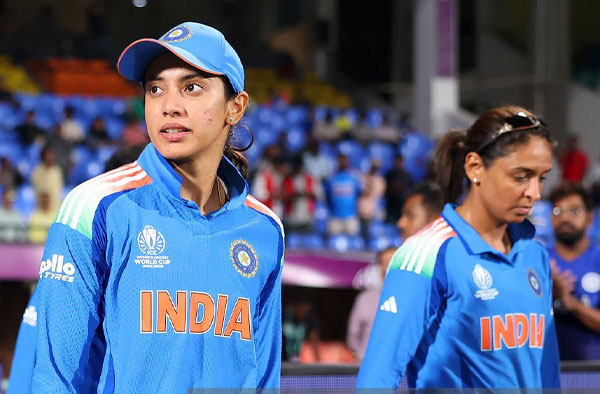
In matches against Sri Lanka, Pakistan, and South Africa, the top order has struggled to lay a solid foundation. Against Sri Lanka, Pratika Rawal showed some grit with 37 runs off 59 balls, but other key players fell early. Smriti Mandhana scored only 8 runs off 10 balls, while Harleen Deol briefly steadied the innings with 48 runs at a strike rate of 75. Jemimah Rodrigues was dismissed without scoring, and Richa Ghosh added just 2 runs, leaving India in a precarious position at 124 for 6. A similar trend continued against Pakistan, where Pratika (31), Smriti (23), Harleen (46), and Jemimah (32) contributed but failed to build momentum, resulting in a score of 159 for 5. The match against South Africa was even more alarming, with early wickets falling cheaply, leaving India at 102 for 6. Only Pratika and Smriti managed to score 37 and 23, respectively, as the top order collapsed once again.
The lower-middle order has been a crucial asset during these batting collapses. Against Sri Lanka, Amanjot Kaur made 57 off 56 balls and Deepti Sharma steadied 53 off 53, forming a vital 103-run partnership for the seventh wicket, shifting the momentum. Sneh Rana contributed a quick 28 off 15 balls, bringing the total to a more competitive level. Richa Ghosh has emerged as a strong hitter, notably scoring 94 off 77 balls against South Africa, which included 11 fours and 4 sixes, helping India reach a respectable total of 251. These late-order contributions from Amanjot, Deepti, Richa, and Sneh have repeatedly saved India from significant collapses, but the heavy reliance on them highlights a fragile batting lineup.
Compounding India’s challenges is the quality of spin bowling they will soon encounter. England has a formidable spin trio of Charlie Dean, Sophie Ecclestone, and Linsey Smith, who have combined for seven wickets in both matches for England, playing a crucial role in bowling out South Africa for just 69 runs and effectively restricting Bangladesh.
New Zealand’s Lea Tahuhu and Amelia Kerr present a tough combination of pace and spin variations that can trouble batters. In the recent match of New Zealand, the bowling attack restricted Bangladesh for 127. Australia’s bowling unit, led by Alana King, Annabel Sutherland, and Sophie Molineux, has been dominant, helping to bowl Pakistan out for a mere 114 runs and dismantling New Zealand’s batting.
India’s upcoming matches against Australia on October 12, England on October 19, and New Zealand on October 23 will pose significant tests. These teams feature some of the best spin bowling attacks in the tournament, and India’s top order must provide stable starts to avoid early collapses. The current trend of losing early wickets and relying on the lower-middle order is unlikely to work against such high-quality bowling.
India’s batting inconsistencies and susceptibility to spin bowling raise concerns about their ability to score or chase significant totals in the crucial matches ahead. Unless the top order finds its form and the team develops effective strategies to counter world-class spin attacks, India’s World Cup campaign may face serious setbacks at this critical juncture. Immediate improvements in batting resilience and tactical planning will be essential for India to compete effectively against the tournament’s strongest teams.

Loves all things female cricket