Cricket Australia has achieved a major milestone ahead of schedule, with its 2024-25 census revealing 103,232 South Asian Australians registered for cricket participation the season, surpassing the strategic target of 100,000 set for 2027 by a full two years.
The goal was part of Cricket Australia’s broader aim to have 8% South Asian representation at first-class, state, and W/BBL level by 2027, up from the current 4.2%, as of 2023.
The push has been championed by key figures such as Usman Khawaja, Alana King, and Lisa Sthalekar, who played central roles in creating the new Multicultural Action Plan, launched at the MCG. While South Asian engagement has been a particular focus, the plan, and the funding attached, is designed to benefit all multicultural communities.
For the sixth consecutive season, Singh is the most common surname among registered players, followed by Patel, Smith, Sharma, and Williams, a clear reflection of Australia’s growing cricket diversity.
Names like Jason Sangha and Tanveer Sangha headline this new wave, alongside Indian-origin girls, Hasrat Gill and Samara Dulvin, who have become household names within South Asian circles and shone in tournaments such as last year’s U19 Women’s Tri-Series and also making their mark in elite domestic competitions.
The Multicultural Action Plan seeks to break down barriers, build trust, and foster stronger relationships across all communities. It focuses on inclusive pathways, deeper community engagement, and greater visibility for multicultural talent across every level of the sport.
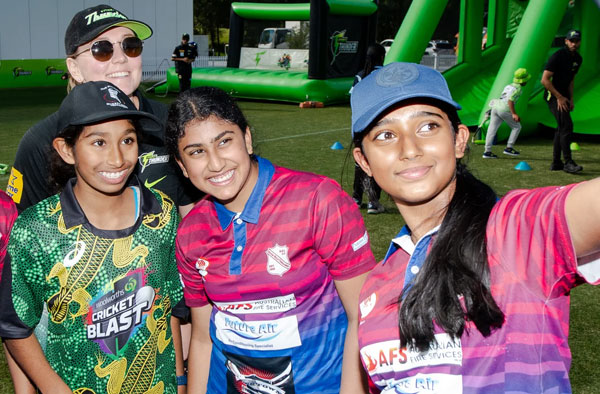
Growth has been particularly strong among young players. South Asian boys aged 5 to 12 saw participation rise by 7% to 21,914, while girls in the same age group jumped 8% to 5,346. In the Cricket Blast program, South Asian girls rose by 11% to 4,909 participants, with boys up 5% to 12,109, signs of strong family engagement and early love for the game.
The impact is also visible at the elite development level, where South Asian Australians now make up 17% of juniors in Cricket Australia’s talent pathways. Among under-12s in national talent programs, 43% of boys and 25% of girls are of South Asian heritage, remarkable numbers given the community represents just 6% of Australia’s population.
Female participation continues to climb nationally, with a 6% overall rise and an 11% increase in girls joining Cricket Blast. South Asian girls have been central to this surge, inspired by relatable role models and supported by inclusive programming. Overall, Cricket Australia’s registered participation grew to 669,642 this season, with club cricket rising to 348,221 and school competitions holding steady at 95,818.
Cricket Australia’s milestone comes at a time when the sport is hearing louder calls for stronger Asian representation at the top level. Sri Lankan captain Chamari Athapaththu says giving more South Asian girls a shot is vital for cricket’s growth.
She said, “Franchise cricket is not all about money, it’s about learning new skills, culture and getting experience. I know many women players from India, Pakistan, Bangladesh and Sri Lanka who are keen to feature in WBBL due to the standard and pace of cricket over here.
“I would urge franchises to give more South Asian girls an opportunity to shine in WBBL. WBBL is one of the best franchise leagues and I will take this knowledge to the young players of Sri Lanka.”
This milestone isn’t just about numbers, it’s about belonging. The surge in South Asian participation shows how cricket, often called Australia’s summer heartbeat, is opening its doors wider than ever. Behind each registration is a child discovering the joy of the game, a parent finding a new community, and a family building connections through sport.
(Inputs sourced from Cricket Australia media release)

Loves all things female cricket