Women’s cricket entered the conversation of the Olympics not as an additional concept, but as a structurally well-matched discipline that line up with how the Games operate in today’s times.
Unlike legacy setups that are burdened by long match durations and strict calendars, women’s cricket has evolved in parallel with shorter formats, centralised governance, and digital-first consumption. This change makes Olympic integration a practical matter of how well the sport fits the schedule and setup, not just a token sign of recognition.
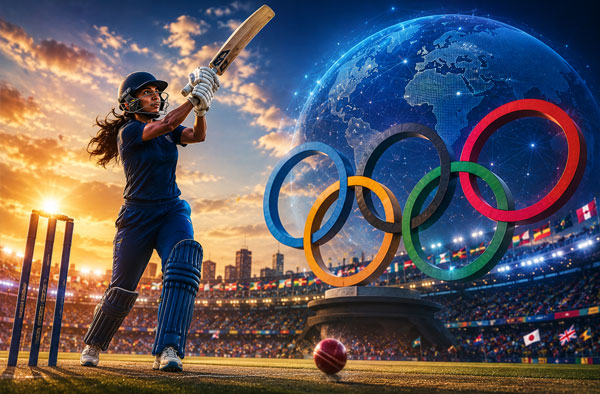
The shift is visible in modern sports ecosystems, which include analytical and staking environments used by platforms such as Rajbet casino, where women’s cricket is there as a data-native, fast competition.
For the LA 2028, women’s cricket fits in because it meets the constraints of the Olympics statistically, precisely, and economically.
Format and Scheduling Align With Olympic Constraints
Women’s cricket have dodged many of the structural burdens that had delayed the men’s game previously, by sticking to shorter, standard game formats that map out smoothly onto the strict Olympic timetable
Format Compatibility Metrics
| Metric | Women’s Cricket
(T20) |
Olympic
Requirement |
Outcome |
| Match duration | 160–180 minutes | ≤3 hours | Compatible |
| Overs per side | 20 | Fixed-length | Predictable |
| Matches per
venue/day |
2–3 | High density | Efficient |
| Tournament span | 7–9 days | ≤10 days | Fit |
| Turnaround time | 75–105 minutes | Venue rotation | Acceptable |
| Weather
contingencies |
Reduced overs | Result integrity | Stable |
| Medal format | Single tournament | Clear podium | Aligned |
Thus, Women’s cricket fits the Olympic substructure without requiring special spaces or extended venue blocks.
Star Power and Athlete Visibility Strengthen Olympic Fit
Women’s cricket enters the Olympics 2028 with a generation full of athletes who are already functioning at a global scale, combining elite performance, cross-border recognition, and measurable commercial pull.
Unlike the previous Olympic inclusion cycles, which were driven by federations, women’s cricket arrives with individual athletes, who run as independent audience drivers across broadcast, digital, and sponsorship networks.
- Smriti Mandhana: One of the most familiar figures in global women’s cricket, who unswervingly ranked among the top batters across setups, with a high engagement reach in India’s 1.4B+ market, regular prime-slot broadcast presence, and strong brand partnerships.
- Ellyse Perry: As a rare icon who has dominated in both football and cricket, Ellyse Perry brings a perfect Olympic narrative to the stage. She combines elite, all-round athletic performance with decades of worldwide recognition
- Harmanpreet Kaur – Famous for stepping up in the biggest global tournaments, especially with those match-winning innings in ICC events. Her strong leadership and big-game presence are a perfect fit for high-stakes Olympic medal chases.
- Nat Sciver-Brunt: Brunt stands out is her pure consistency. She’s incredibly reliable, not volatile, which aligns perfectly with the Olympic ideal of rewarding athletes who deliver top-tier performances time after time.
- Beth Mooney: When the stakes are highest, Beth Mooney delivers. She is incredibly efficient in major tournaments, and her history of winning knockout matches makes her the perfect fit for the intense, win-or-go-home format of the Olympics.
- Shafali Verma: As a rising star with an explosive batting style, Shafali Verma is young enough to play in multiple Olympic Games. She’s exactly the kind of player who can stay at the top of her game for LA 2028 and beyond.
- Sophie Ecclestone: As a dominant force at the top of the global rankings, Sophie Ecclestone proves her value with every spell she bowls. She has the unique ability to completely turn a short-format match around on her own, making her a perfect standout for the Olympic stage
- Meg Lanning: When you think of Meg Lanning, you think of winning trophies. Her legacy as a master captain who consistently delivers tournament victories fits beautifully into how Olympic team sports are judged and celebrated
These athletes matter because Olympic inclusion increasingly depends on recognizability, repeatability, and narrative clarity.
Women’s cricket enters LA 2028 with a unit of players whose performance profiles, audience reach, and competitive reliability already function within global multi-sport ecosystems rather than niche cricket-only contexts.
Women’s Cricket Operates as a Data-Native Olympic Sport
Women’s cricket already operates inside the same known logic required of Olympic disciplines, particularly when there is high-frequency data capture, oversight, and broadcast workflows that are automated.
This is not an adaptation for the latter, but an existing state of operation that is shaped by short formats, data providers that work on the central, and uniform officiating technology.
System-Level Compatibility Profile
| System Layer | Women’s Cricket Today | Olympic Standard | Effect |
| Data granularity | Ball-by-ball (300–360
events/match) |
High-frequency | Compatible |
| Data latency | <1 second (often ~300–500
ms) |
Near-instant | Live-ready |
| Integrity coverage | 100% of ICC tournaments | Continuous | Trust |
| Broadcast format | Modular overs/phases | Slot-based | Scalable |
| Highlight generation | 30–90 seconds | Automated | Digital fit |
| Officiating tech | DRS, ball tracking, edge
detection |
Standardized | Fairness |
These parameters place women’s cricket within the same technical envelope as established Olympic sports that rely on real-time scoring, instant verification, and centralized distribution.
How This Works in Practice:
- 300+ distinct data events in per match (deliveries, runs, wickets, reviews, player positions) are taken in note, and distributed, enabling unified incorporation with centralised Olympic results systems.
- Sub-second data already feeds power live scoreboards and broadcast graphics in ICC women’s events, matching latency requirements used across Olympic timing and scoring platforms.
- Continuous monitoring is applied throughout entire tournaments rather than just isolated matches, with irregularity detection running in real time instead of the post-event evaluation.
- Highlight production that is automated, and mostly used in women’s international and franchise cricket, converts key scenes into broadcast-ready clips within 30–90 seconds, in line with the Olympic digital delivery policy
- Technology-assisted managing, which includes ball tracking and edge finding provided by systems such as Hawk-Eye Innovations, that reduces subjective variance and brings times of decision review into the 10–20 second bracket doable for live Olympic broadcasts.
- Flexible venue deployment, which is already not very uncommon in women’s T20 tournaments, and it allows the matches to be staged in shared or temporary stadiums without permanent cricket-specific infrastructure, reducing host-city capital expenditure.
Women’s cricket thus approaches LA 2028 not as a growing or trial inclusion, but as a fully system-suited Olympic discipline, already in line with the requirements for games’ data integrity, broadcast automation, and scalability of operations.
Conclusion
Women’s cricket is a right fit for the Olympics 2028 because it was built for modern limitations. Short formats, fast data, growing global audiences, and technical compatibility spot it as a sport that is Olympic-ready by design.
Operational alignment is clearly reflected in its inclusion and market logic, not symbolic progress, strengthening how the Games now choice disciplines for measure and sustainability.

Loves all things female cricket