Moments after India sealed their 52-run victory over South Africa to lift their first-ever Women’s ODI World Cup title, the players walked out in jerseys that already declared them “Champions.” To the world, it looked like seamless planning. In reality, it was an audacious gamble stitched together in secrecy and conviction.
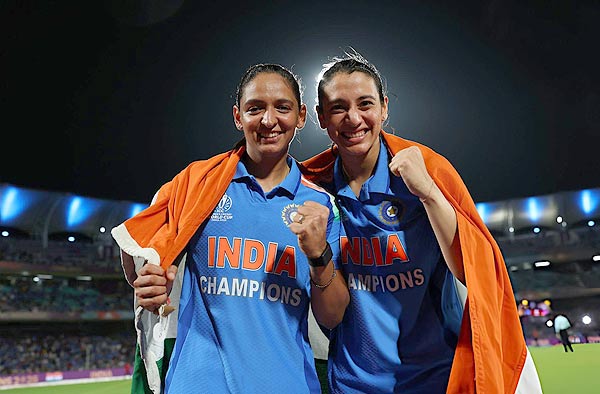
The chain of events began two days earlier, when India defeated Australia in a dramatic semi-final chase at the DY Patil Stadium. That win did more than propel Harmanpreet Kaur’s squad into the final — it ignited a belief strong enough to trigger a bold, quiet decision behind the scenes.
According to a team source involved in the process, “When our women’s team won the semi-finals, there was just about time to place an order for special jerseys because otherwise it would have been too late for our kit manufacturer to prepare them in time for the final which was just two days later.” He further shared that “The belief was very strong that this time the World Cup would be ours, especially after the win over Australia.”
With just a narrow window before the final, that belief had to translate into action. This resulted in the early order for the special jerseys, purely on faith. As the source explained, “I took the chance of going ahead and ordering the champions jerseys.” Had South Africa prevailed, the entire batch would have stayed packed in the BCCI inventory room, waiting for some future celebration.
The operation itself was crafted as a one-person mission, and the plan of the jerseys was kept top secret. Not a single member of the squad or support staff had an inkling. In his words, “Nobody in the team — players, coaches or the other support staff members — knew that these special jerseys were being prepared.”
The jerseys were hidden away at the team hotel until the final reached its decisive phase. Once South Africa lost their eighth wicket — Chloe Tryon’s dismissal — the wheels were set in motion.
As the source revealed, “The box of jerseys was kept hidden in the team hotel. I got them to be delivered to the DY Patil Stadium only after the eighth South African wicket fell (of Chloe Tryon) in the final.” For him, the purpose was simple and emotional, “The idea was to make the moment really special and memorable for the team,” the source concluded.
[embedpress]https://x.com/imfemalecricket/status/1985069919906459986?t=QyYIIqe6wPnASe7pzepg9w&s=19[/embedpress]
If the jerseys symbolised destiny, India’s journey to that moment symbolised resilience. Their campaign began unevenly. Reduced to 124/6 against Sri Lanka in their opener, they recovered through lower-order defiance to post a DLS-adjusted 271 and won by 59 runs (DLS method). They built momentum against Pakistan with a 248-run total and an 88-run victory. Then the slide began — three back-to-back losses that nearly derailed the campaign: by 3 wickets to South Africa, by 3 wickets to Australia, and by just 4 runs to England.
Suddenly, every match mattered. Against New Zealand, India delivered under pressure, posting 340/3 in 49 overs and winning by 53 runs (DLS method), securing qualification. Their final league match against Bangladesh ended without a result, leaving them fourth on the table and earning a semi-final date with the defending champions and the only unbeaten team in the tournament.
Australia put up 338 in that semi-final, but what followed became one of India’s greatest ODI chases. Jemimah Rodrigues crafted an unbeaten 127, supported by Harmanpreet Kaur’s 89, steering India into their third World Cup final.
At the DY Patil Stadium, India carried that momentum into a night thick with expectation. Their bowlers held South Africa to a total 52 runs short, delivering the country its first Women’s ODI World Cup title. When the final wicket fell, the roar that rose from the stands seemed to meet a generation’s longing. And when the players slipped into their hidden, secretly-prepared jerseys, the story completed itself — belief became decision, decision became history.
(Quotes sourced from mid-day)

Loves all things female cricket