The night UP Warriorz finally got on the board in Women’s Premier League (WPL) 2026 felt less like a simple seven-wicket win and more like a referendum on their new head coach’s philosophy.
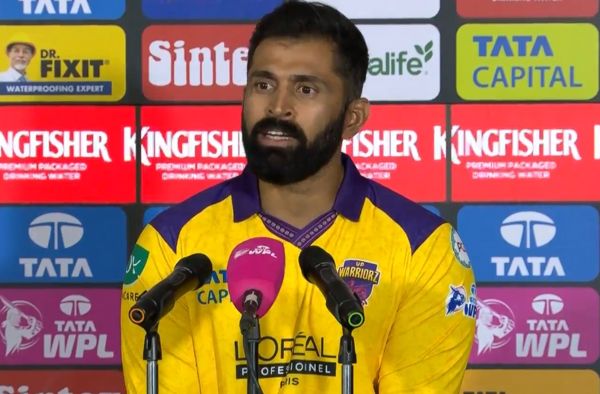
At DY Patil Stadium on 15 January, with playoff hopes already wobbling after three straight defeats, Abhishek Nayar, the first Indian to be a head coach in the WPL, walked into the post‑match press conference with the air of a man vindicated, but not distracted. The scorecard read a convincing win over two-time champions Mumbai Indians; the story, though, was about trust, communication and a dressing room that refused to fracture after a stormy 24 hours.
All eyes, inevitably, were on his handling of Harleen Deol. Less than a day earlier, Nayar had been at the centre of a social‑media firestorm after the 27‑year‑old was retired out on 47 against Delhi Capitals. In Navi Mumbai, she responded with a commanding 64* off 39 balls, her 3rd WPL half-century, to seal UP’s first win of the season. Nayar’s explanation of the call to retire her against Delhi revealed a process far more nuanced than the outrage suggested.
[embedpress]https://x.com/i/status/2011859638309044486[/embedpress]
“I think the conversation wasn’t like a very spontaneous decision,” he said, carefully revisiting the timeline. “We started around the 12th over, by the timeout in the 14th, Meg decided to have a go and Harleen as well. At that point, we had already communicated to Harleen that if we don’t get going till the 16th or 17th over, we will look for a change.”
From the outside, it looked brutal. Inside the Warriorz camp, Nayar stressed, it was a tactical call built on prior communication rather than impulse. The way Harleen batted against Mumbai, 12 boundaries, tempo in control, risk minimal, felt like a direct continuation of that internal conversation rather than a rebellion against it. With 122 runs at a strike rate of 134.06 and an average of 40.66 in four innings so far this season, she is the 3rd highest run-scorer for the UP Warriorz. She has quietly become the middle-order fulcrum around which this UP campaign will turn.
If the retired-out episode threatened to dent player-coach trust, Nayar was keen to underline the personality of the cricketer at the centre of it. His first impressions of Harleen have clearly shaped the way he has coached her through a tricky emotional stretch. “The one thing that always stood out was how much of a team player she is,” he said. “She always thinks team first, Harleen second. Even in the field, if you watch her run around, you feel that. So, the conversations post that were more about making sure she’s okay, about the stigma when people talk about it without knowing what’s happening.”
The numbers now reflect that resilience. Harleen’s 64* came with UP in early trouble at 45/2 in the seventh over, chasing 162 after Nat Sciver‑Brunt’s high-class 65 off 43 and Nicola Carey’s 32* off 20 had powered Mumbai to 161/5. Harleen wasted no time as she unleashed a flurry of boundaries purely backed by timing and gap-finding skill alongside Phoebe Litchfield in a vital 73‑run stand for the third wicket and seamlessly played 2nd fiddle to Chloe Tryon towards the backend in a blistering 44-run partnership that finished the game with 11 balls to spare.
For Nayar, though, it’s not just about a one‑off innings; it’s about redefining her ceiling. “Everyone has recognised Harleen and Deepti as touch players,” he explained. “I want to bring them to a place where they are touch and power, aaj se leke agale saal tak, I want them to be different players.” On a night when Harleen became only the second Indian after Harmanpreet Kaur to register a fifty in this edition, those words carried particular weight.
UP Warriorz came into Match 8 in do-or-die territory. Three losses in three could easily have turned the dressing room insular or brittle. Nayar’s response, as he laid out, has been to de-link mood from results and focus on incremental growth, the kind of long-view thinking often missing in T20 leagues.
[embedpress]https://x.com/i/status/2011852360025587852[/embedpress]
“For me, my team will always be the best team. They may not perform on a particular day, so the atmosphere doesn’t change,” he insisted. “When I first took up this job, it was about making sure that if a player is at point A, by the end of the season I can take them to point B, and maybe next year to point C, winning or losing is key, but making sure the players are in a mindset to come and enjoy and be a better player is the key focus.”
That philosophy has been visible even through the early losses, karaoke sessions, Shikha Pandey on the guitar, and dancing in the team room have already become part of the Warriorz narrative. “Regardless, we’ll dance even after we lose, we’ll dance even after we win,” Nayar said with a smile. It might sound like a throwaway line, but in a league with relentless scrutiny and limited time to reset, maintaining a playful, stable environment is a competitive edge.
Alongside the big-picture talk, Nayar offered insight into the micro-work being done with individuals. Opener Kiran Navgire’s returns so far have not matched the hype she carried in after a strong domestic season, but the coach’s messaging around her has been strikingly protective.
“It’s been hard for her so far in this tournament because she came in with a lot of expectations,” he admitted. “These conditions have not necessarily suited her yet. But what we’ve tried to do is make sure she can still give herself the best chance by being aggressive. That is who she is.”
Against Mumbai, that translated into small but meaningful adjustments: more strike rotation, ensuring she and Lanning got through the powerplay while still looking for boundary options. Navgire’s 10 off 12 may not leap off the scorecard, but it helped set a platform that Harleen and Tryon later exploited. “In this format, it’s cruel,” Nayar said. “You want to make sure you give them the freedom and the support so they can keep going. When you don’t win, it becomes hard. But when you win, it becomes slightly easier.”
The other pillar of this turnaround, in Nayar’s eyes, is Meg Lanning moving over from the Delhi Capitals to the UP Warriorz for the ongoing season for 1.90 CR in the mega auction. Handed the captaincy of a side under pressure and still getting used to new personnel, she has, in his words, become “the boss of the team”.
“T20 is about having a good captain,” he reiterated. “She can have fun with the girls, but she’s very meticulous with the planning, sitting with the bowlers, sitting with the batters, testing us with lots of questions about stats, matchups, areas. She’s learning their strengths and weaknesses because it’s new to her as well. I’m pretty sure in time she’ll go from strength to strength.”
If Lanning is still feeling her way into this group, Nayar is doing much the same with the nuances of coaching a women’s franchise side. A seasoned operator in men’s domestic and IPL environments, he was refreshingly candid about how steep the learning curve has been. “In women’s cricket, the attention to detail is a little more crucial,” he said. “Sometimes you need to sort of break it down. I’m also teaching myself every day, listen, Abhishek, open your mouth, talk. They’re so receptive to it, it’s amazing, trust takes time, and I’m working around that.”
Central to that trust, he insists, is listening more than speaking. “First, you don’t talk, you listen,” he explained when asked about managing senior players and a talent-heavy squad. “You want to hear what they feel, not tell them what you feel. Once you understand that, then you see where you want to navigate and go with it, so you can bring them to a place where they are clear in their mind to perform.”
On the field, there were multiple positives for UP that reinforced those themes. Lanning’s decision to bowl first was backed by a disciplined unit that, despite Nat Sciver‑Brunt’s record‑equaling 10th WPL fifty and Carey’s late charge, kept Mumbai to a chaseable 161/5. In reply, the top order absorbed the early blows, both openers falling to Nat in a single over. There was no panic.
[embedpress]https://x.com/i/status/2011853570149331041[/embedpress]
From there, Harleen’s controlled aggression and crisp gap-finding alongside Tryon’s 27* off 11 brought the Warriorz home with 7 wickets and 11 balls to spare, a margin that not only boosts net run rate but also sends a message that this is not a side ready to fade away after a 0–3 start. Tryon’s own story, retired in for against Delhi, finishing the job alongside Harleen against Mumbai, underlines Nayar’s point about process over one-off outcomes.
There is still work to do. The bowling will want more penetration at the top, the middle order will know tougher chases lie ahead, and Nayar himself is the first to admit “it’s not been easy”. But as the first Indian head coach in the WPL, he is quietly reshaping what leadership in this league can look like: data-driven yet human, demanding yet empathetic, honest yet relentlessly upbeat.
For now, the UP Warriorz have their season alive, their environment intact, and their key players, not least Harleen Deol, trending upwards. If Nayar can keep taking them from point A to point B, and eventually to point C, this seven‑wicket win over the defending champions might, in hindsight, read as the night their campaign truly began.

Loves all things female cricket