As the 13th edition of the ICC Women’s ODI World Cup 2025 enters its critical knockout phase, one looming question dominates the minds of fans and teams alike. What happens if rain washes out the semi-finals?
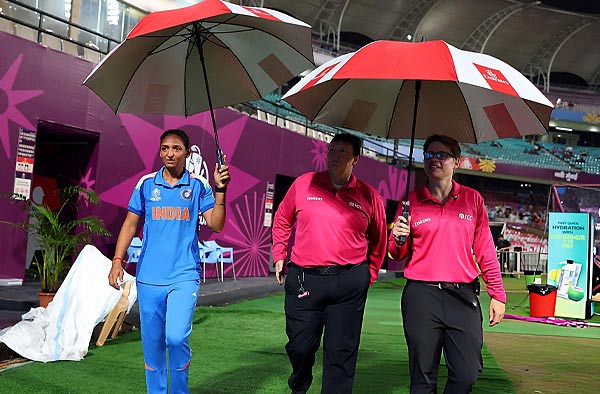
With forecasts warning of possible showers in Guwahati and Navi Mumbai, venues hosting the two high-voltage semi-finals, the International Cricket Council’s reserve day policy could soon face its most consequential test. Under the current rules, both semi-finals and the final (scheduled for November 2) have dedicated reserve days to ensure a result. Yet, if the play cannot be completed even across two days, the team finishing higher on the points table will advance to the final.
England vs South Africa: History Revisited, Weather Permitting
The first semi-final on October 29 at the Barsapara Cricket Stadium, Guwahati, brings two form-heavy sides together: England, led by Nat Sciver-Brunt, and South Africa, captained by Laura Wolvaardt. England finished second on the points table with 13 points from seven games, their only defeat coming against Australia.
Their campaign was built on early dominance: a 10-wicket opening win against South Africa, a four-wicket chase against Bangladesh, and a comprehensive 89-run victory over Sri Lanka in Colombo. Even a washed-out game against Pakistan couldn’t derail them, as they edged India by 4 runs in Indore and sealed their group stage with an 8-wicket win over New Zealand in Visakhapatnam.
South Africa, by contrast, endured a rollercoaster start. A 10-wicket defeat to England in their opener was quickly buried under a surge of consistency, five consecutive wins across Indore, Visakhapatnam, and Colombo, including a notable 150-run dismantling of Pakistan on 21st October. But a crushing 7-wicket defeat to Australia in their final league game left them third with 10 points, setting up what feels like poetic déjà vu: the exact semi-final pairing of the 2017 edition, where England held their nerve to edge the Proteas out in a heart-stopping finish.
Should the Guwahati skies intervene, England holds the advantage. As higher-ranked finishers, Nat Sciver-Brunt’s side will progress to the final if the match is abandoned after all possible play and the reserve day yields no result.
India vs Australia: A Clash of Powerhouses Under Clouded Skies
The second semi-final on October 30 at the DY Patil Stadium, Navi Mumbai, bears the weight of history and high expectations. Hosts India, under Harmanpreet Kaur, come into this knockout after a recovery-laden group stage, striking early wins against Sri Lanka and Pakistan before enduring a mid-tournament slump with three consecutive losses to South Africa, Australia, and England. India’s revival came through a commanding 53-run win over New Zealand in rain-troubled Navi Mumbai, before their final league clash against Bangladesh was washed out, leaving them fourth on the table.
Australia, led by Alyssa Healy, arrives unbeaten and brimming with balance. They topped the league stage with 13 points, registering six wins and one washout, the most complete side in the competition by far. Despite Healy’s minor calf injury keeping her briefly out of the last two matches, stand-in skipper Tahlia McGrath guided the side with the same poise, overseeing impressive wins against England and South Africa at Indore. Their campaign highlights include emphatic wins over New Zealand, Pakistan, and Bangladesh, reaffirming Australia’s unmatched depth across formats.
The rain threat at DY Patil Stadium brings stark implications. Should both scheduled and reserve days be washed out, Australia, as higher-ranked finishers, will qualify for the final, leaving India’s campaign heartbreakingly dependent on weather patterns. However, every effort will be made to produce a result within the two-day window, including reduced-over contests if needed, ensuring fans see a contest worthy of the stage.
The Broader Picture: ICC’s Rain-Ready Policy and Past Rain Impacts
The ICC’s preparedness for rain disruptions has been rigorously tested this World Cup. Six matches have been abandoned (and another 4 games) or significantly curtailed by rain, including India vs Bangladesh, Sri Lanka vs Australia, and Pakistan vs Sri Lanka, underlining the challenging subcontinental weather cycle during October. Venues such as Colombo witnessed multiple washouts, impacting teams like Sri Lanka and Pakistan more visibly.
The governing body’s reserve day safeguard ensures both fairness and completion integrity. The rules are clear:
- Every semi-final and the final have a reserve day.
- Every attempt will be made to finish the game on the original day, including via overs reduction.
- Only if the game remains incomplete even after two days will the higher-ranked team at the end of the league stage advance.
- This framework upholds both sporting merit and practicality, critical in tournaments of this magnitude.
Historical Echoes and the Stage Ahead
These semi-final matchups evoke rich parallels with past editions. In 2017, England defeated South Africa in the semi-final before lifting the trophy, while India stunned Australia in a classic thriller in Derby, led by Harmanpreet Kaur’s 171*. As fate would have it, the 2025 lineup mirrors that exact scenario. The storylines, however, come steeped in fresh form, evolving squads, and unpredictable weather shadows.
If rain intervenes again, it will test not just scheduling resilience, but also the emotional endurance of teams who have fought through fluctuating conditions across India and Sri Lanka. The Barsapara and DY Patil venues, both affected by previous rain interruptions, might yet define this World Cup’s narrative.
Whether the skies relent or not, one truth stands firm: cricket has rarely seen a women’s World Cup final race as tightly poised, where both form and forecast share equal billing.

Loves all things female cricket