The 13th ICC Women’s ODI World Cup 2025 has entered its knockout stage, setting up two mouth-watering semi-final clashes that promise high-intensity cricket and emotional depth. The first semi-final will see England, led by the dynamic Nat Sciver-Brunt, face a resurgent South Africa, captained by Laura Wolvaardt, on 29th October 2025 at the Barsapara Cricket Stadium in Guwahati from 3 PM IST.
A day later, on 30th October, India under Harmanpreet Kaur will lock horns with a dominant Australian outfit led by Alyssa Healy at the DY Patil Stadium, Navi Mumbai, two fixtures that encapsulate the journey, grit, and brilliance of the world’s best.
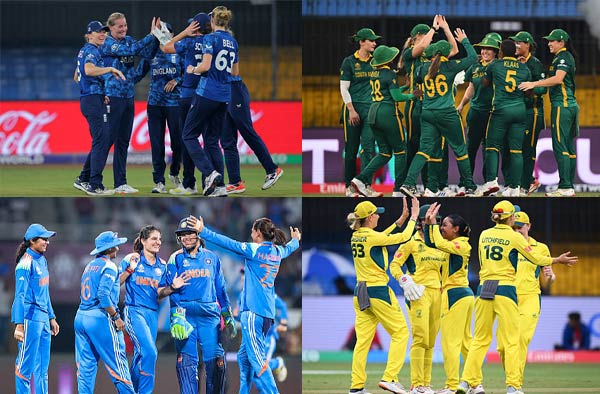
Semi-Final 1: England Vs South Africa
For Nat Sciver-Brunt’s England, the journey to the semi-final has been defined by resilience and attacking balance. England sits third on the points table with nine points from six games, a campaign shaped by dominant early wins and stern late challenges. Their journey began emphatically, sweeping aside South Africa by 10 wickets on 3rd October in Guwahati and following it up with a four-wicket victory over Bangladesh on 7th October at the same venue. A commanding 89-run win against Sri Lanka in Colombo on 11th October further strengthened their early form.
A washed-out fixture against Pakistan in Colombo on 15th October slightly checked their momentum, but their thrilling four-run triumph over India on 19th October at Indore showed England’s composure under pressure. Their only defeat came against Australia on 22nd October at Indore, as the side led by the stand-in skipper, Tahlia McGrath, outplayed them by six wickets. England will complete their league schedule against New Zealand at Visakhapatnam on 26th October, a precursor to their high-stakes rematch against South Africa in the semi-final.
Statistically, Heather Knight’s consistency has been the backbone of England’s batting. The former skipper is their leading run-scorer with 255 runs at an average of 63.75 and a strike rate of 87.03, including a classy century and a crucial half-century. With the ball, Sophie Ecclestone remains England’s trump card. Her tally of 11 wickets at an average of 16.36 and an economy rate of just 3.95 makes her one of the tournament’s most influential bowlers.
South Africa, meanwhile, returns for redemption. After starting their campaign with a 10-wicket drubbing from the same English unit, Laura Wolvaardt’s team produced a ferocious comeback, stringing together five consecutive victories to assure their semi-final berth before the final league fixture. They sit second on the table with 10 points from seven matches, boasting wins over powerhouses like India (by 3 wickets on 9th October at Visakhapatnam) and a record 150-run victory over Pakistan in a rain-curtailed clash in Colombo on 21st October.
Fueled by a strong top order and a rejuvenated bowling attack, South Africa’s campaign gained momentum after beating New Zealand by 6 wickets on 6th October and Bangladesh by 3 wickets on 13th October. Their 10-wicket win over Sri Lanka on 17th October showcased their all-round supremacy. However, their seven-wicket defeat to Australia on 25th October in Indore, being bowled out for just 97, served as a reminder of the fine margins at this level.
Wolvaardt’s leadership has been authoritative both tactically and statistically. She leads South Africa’s batting with 301 runs at an average of 50.16 and a strike rate of 89.31, including three composed half-centuries. On the bowling front, Nonkululeko Mlaba has been South Africa’s most effective weapon, matching Ecclestone’s tally of 11 wickets at an average of 18.90 and an economy of 4.83, underpinning her side’s middle-overs dominance.
With the Guwahati surface historically offering a balance between pace and spin, the England–South Africa semi-final promises a gripping contest between Sciver-Brunt’s calm execution and Wolvaardt’s fierce adaptability, a rematch layered with narrative subtext and competitive intrigue.
Semi-Final 2: India vs Australia
The second semi-final brings an emotional crescendo to the tournament, hosts India meeting their long-time rivals Australia on 30th October at the DY Patil Stadium, Navi Mumbai, from 3 PM IST. The clash is poised to be a repeat of the 2017 face-off in a semi-final clash. India, placed fourth with six points from six matches, endured a rollercoaster campaign marked by high peaks and deep troughs. The Harmanpreet Kaur-led side began impressively, defeating Sri Lanka by 59 runs in the tournament opener at Guwahati on 30th September, followed by an emphatic 88-run win against Pakistan in Colombo on 5th October.
But the tournament soon tested their resilience, as they slipped to three successive defeats, against South Africa (by 3 wickets on 9th October at Visakhapatnam), Australia (by 3 wickets on 12th October at Visakhapatnam), and England (by 4 runs on 19th October at Indore).
Their revival came against New Zealand, where a collective effort sealed a comprehensive 53-run victory at Navi Mumbai on 23rd October, sealing their spot in the semi-final. India’s final group-stage battle against Bangladesh on 26th October at the same venue will serve as a tune-up before facing the formidable Australians.
India’s batting brilliance has been headlined by their prolific opening pair. Smriti Mandhana tops the tournament charts with 331 runs at an average of 55.16 and a strike rate of 100.60, while Pratika Rawal follows closely with 308 runs at 51.33 and a strike rate of 77.77. Deepti Sharma has anchored India’s bowling with 14 wickets at an average of 22.35, emerging as a key match-winner in the middle overs.
Australia, led by Alyssa Healy, have been the benchmark through the 2025 campaign, the only unbeaten team so far, topping the table with 13 points from seven games, including six wins and a washed-out fixture. Their journey began with a crushing 89-run win over New Zealand on 1st October in Indore and continued with clinical performances against Pakistan (by 107 runs on 8th October), India (by 3 wickets on 12th October), and Bangladesh (by 10 wickets on 16th October).
Even in Healy’s absence due to a minor calf strain, stand-in skipper Tahlia McGrath led the side to commanding victories over England (by 6 wickets on 22nd October) and South Africa (by 7 wickets on 25th October), further emphasising the team’s depth and adaptability.
Alyssa Healy remains the driving force in the batting department, scoring 294 runs at an average of 98 and a strike rate of 131.25, decorated with two centuries. Annabel Sutherland has stormed the bowling charts as the tournament’s leading wicket-taker with 15 wickets at an exceptional average of 13.33 and an economy of 3.97, including a career-best five-wicket haul against India.
When India and Australia meet in Navi Mumbai, the stage will not just host a semi-final but a story of perseverance, of a side rediscovering its rhythm against an unbeaten titan. With India aiming for redemption and the crowd behind them, and Australia’s pursuit of an unblemished run, the DY Patil Stadium will witness a clash both statistical and emotional in magnitude.

Loves all things female cricket