Why Sports, Short Clips, and Streaming Now Move Together
Digital entertainment in Nepal in 2026 no longer breaks neatly into categories. Sports sit next to short-form video, highlights travel through messaging apps before TV recaps do, and one phone screen often carries the whole evening: live score, reaction thread, clip, meme, and discussion. The latest broad country snapshot for 2026 shows 16.6 million internet users in Nepal, 14.8 million social media user identities, and 32.4 million mobile connections, while the median age remains just 25.3. That combination matters. It means a relatively young audience is shaping habits around speed, portability, and shareable formats rather than old-style appointment viewing.
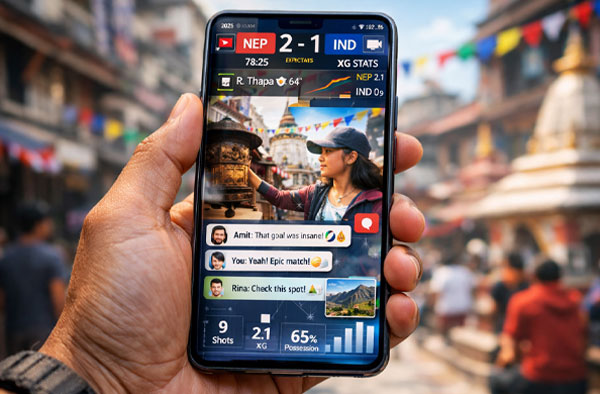
What looks casual from the outside is actually structured behavior. A football fan may start with lineup news, jump to a short clip, open a stats page during the match, then return to social chat after the final whistle. A cricket fan does something similar, only with longer attention around over-by-over swings, strike rates, and win-probability chatter. The point is not that attention spans disappeared. The point is that attention now moves in smaller, faster units.
The phone is the front door now
The mobile phone has become the default entry point to entertainment, not a backup to television or desktop. Official Nepal Telecommunications Authority indicators show mobile broadband at 96 percent and total broadband penetration above 131 percent, a reminder that multiple SIMs and overlapping connections are part of daily reality. DataReportal’s 2026 Nepal report also says 82.8 percent of mobile connections can now be considered broadband.
That changes behavior in ordinary ways. People do not wait to “get home and check later” as often. They check during a commute, between errands, while tea is being poured, or while a match is in the quieter middle phase. Sports content fits this especially well because it arrives in bursts: team news, toss updates, injury notes, clips, cards, wickets, substitutions, and post-match reactions.
A few features now define whether a platform feels useful or forgettable:
- fast score refresh without heavy loading;
- notifications that can be tuned rather than blasted;
- short video that works with patchy attention;
- stat layers that reward curiosity without feeling academic.
Tournaments decide the tempo of conversation
Big events still set the pace. UEFA’s official calendar has the 2025/26 Champions League round of 16 on 10-11 and 17-18 March 2026, which means football discussion is moving in real time right now. The IPL’s official site is already in 2026 fixture mode, and the league’s own auction coverage said the season kicks off in March. The ICC Men’s T20 World Cup 2026, co-hosted by India and Sri Lanka, included Nepal versus England in Mumbai on 8 February in its official fixture list. That is exactly the kind of schedule that keeps digital conversation busy before, during, and after the event itself.
Football pulls in tactical debate and club loyalty. Cricket creates a different rhythm: slower buildup, then sudden bursts of noise around powerplays, death overs, and selection calls. But both now live inside the same ecosystem. The preview is social. The reaction is social. Even analysis is social, because stats no longer stay inside specialist pages; they get screenshotted, clipped, and reposted into mainstream fan talk.
Where fandom becomes interactive
Odds talk joins the second screen
The modern fan rarely stops at watching. During a big European night or a tense cricket chase, the same person comparing xG, strike rotation, or bowling changes may also browse best betting sites in nepal to see how markets price momentum, player form, and late team news. That behavior fits naturally with 2026 sports culture because betting pages now compete on more than odds alone: deeper market menus, live updates, basic statistics, and cleaner mobile flows all matter. The attraction is not just the wager; it is the feeling that numbers keep the match open for interpretation until the very end.
What matters here is timing. A pre-match opinion is one thing. A live price after an early goal, a dropped catch, or a surprise bowling change is another. That is why betting-related behavior increasingly belongs in the same conversation as highlights and analytics rather than sitting in a separate box.
Push alerts changed the rhythm
An evening scroll also works differently once it is app-driven. Many users searching for an online betting app in nepal are really looking for the same things they want from any strong sports product: quicker access, fewer steps, faster notifications, and a layout that makes live markets readable without clutter. On match night, those details matter because attention is fragmented. People bounce between commentary, chat, and scorecards, so the app that loads cleanly and updates quickly usually wins the session.
That design logic mirrors what has happened across streaming and social products. The winners are not always the loudest brands. They are often the products that remove friction at the exact moment interest peaks.
Stats are now entertainment, not homework
One of the clearest shifts in 2026 is that statistics no longer feel like a niche hobby. In football, shot maps, expected goals, progressive passes, and touch heat maps have become normal talking points. In cricket, fans discuss strike-rate pressure, matchup history, economy under dew, and death-over execution with surprising fluency. This is not because everyone became an analyst. It is because platforms turned data into a visible, friendly layer of the viewing experience.
The social platform mix helps too. Facebook still has massive reach in Nepal, Messenger remains a major channel, and Instagram continues to grow. In late 2025, Nepal had roughly 11.0 million Messenger ad-reach users and 4.35 million Instagram users, while LinkedIn also expanded from 2.0 million members in early 2025 to 2.3 million in late 2025. Those are not all sports platforms, of course, but they shape how sports talk travels.
The result is simple: sport is not only watched anymore. It is annotated.
One digital evening, many formats
The old split between “watching a match” and “going online” feels dated. In 2026, they are usually the same thing. A user may begin with a stream, jump to a meme page at halftime, open a stat tracker, message friends, watch a post-match clip, and still return later for condensed highlights. That is one entertainment session, not six separate behaviors.
This is why digital culture in Nepal feels both faster and more layered than it did even a few years ago. The audience is still looking for fun, tension, and community. It just expects them to arrive in a mobile-friendly sequence. The smartest platforms understand that. The rest still treat the experience as a destination rather than a quick, shareable sequence.

Loves all things female cricket