In the dynamic arena of women’s cricket, few moments spark as much debate as team selections in major tournaments. One such moment was India’s semi-final clash against England in the ICC Women’s T20 World Cup 2018 at Sir Vivian Richards Stadium, North Sound, Antigua, where captain Harmanpreet Kaur faced the ironic challenge of steering a side that was missing the experienced Mithali Raj, leading to a controversial defeat by eight wickets.
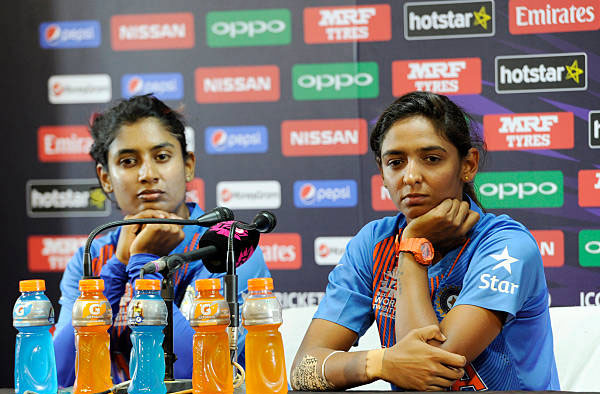
Harmanpreet, known for her aggressive captaincy and powerful batting, shed light on any friction with Mithali Raj in a recent interview with the PTI, saying, “She (Mithali Raj) has been there for the team all the time, and there are no hard feelings. There were a few decisions she made that I didn’t like, but at the end of the day, the team comes first. I’ve always believed that whatever she says or does is for the good of the team. Whether I like it or not, the team is what’s important, and I would just adjust.”
India’s strategy for the 2018 ICC Women’s T20 World Cup semi-final, against England, was influenced by the momentum gained from their unbeaten group run in Guyana, where an attacking approach led by Harmanpreet herself, who scored a scintillating 103 off 51 balls against New Zealand, seemed the perfect formula.
Unfortunately, at Sir Vivian Richards Stadium, where conditions favoured spin and patience, this aggressive approach faltered spectacularly. The top order crumbled from a promising 89 for 2 to a total of 112 all out as Harmanpreet, Veda Krishnamurthy, and Anuja Patil sought aerial shots, underpinning the challenge of adapting strategies to match pitch conditions.
Harmanpreet defended the decision to maintain the same XI that had defeated Australia (by 48 runs), explaining via ESPN cricinfo, “We were going with a winning combination; we did really well against Australia. And that is the reason we just wanted to go with the same combination.” While this consistency approach aimed to reward form and stability, it unfortunately sidelined Mithali Raj, who was fit again after a knee injury and had been India’s top T20I scorer during that period, with back-to-back fifties in the tournament.
The placement of wicketkeeper-batsman Taniya Bhatia opening alongside Smriti Mandhana added firepower, which Harmanpreet believed was crucial for their attacking plan, a plan that had won four consecutive games in the group stage. Despite this, the exclusion of Raj, a veteran with immense experience and record-breaking credentials, sparked debate both on and off the field.
However, Harmanpreet addressed the tensions publicly months later, in January 2019, speaking to Mumbai Mirror, clarifying the relationship between her and Mithali, dispelling notions of bad blood. “I have met [Mithali] and spoken to her after all these events, and we seemed to have moved on. I don’t think there has been any problem between me and Mithali. I can speak for myself. You have to speak to her and ask if she has a problem with me,” Harmanpreet told Mumbai Mirror.
She added, “When you play at an international level, you are mature enough to not let these things affect you. At the end of the day, what matters is that you are playing for your country. A team is like a family where there are troubles and such issues keep cropping up, but they shouldn’t be taken personally.”
This response underscored not just the pressures of international cricket but the interpersonal dynamics within the team, emphasising how leadership extends beyond tactics to emotional intelligence and team cohesion.
Statistically, Harmanpreet Kaur’s credentials as an all-format leader and player are remarkable. Since her T20I debut in 2009, she has amassed 3,654 runs at an average nearing 29, highlighted by 14 half-centuries and one century in 182 matches. Her off-spin has also contributed 32 wickets in T20Is. In the ODI format, with over 4,400 runs, including seven centuries and 31 wickets, her all-round impact on the Indian women’s team is undeniable.
Her leadership peaked spectacularly when, under her guidance and coach Amol Muzumdar, India clinched their maiden ICC Women’s ODI World Cup title in 2025 on home soil at DY Patil Stadium, Navi Mumbai, marking her as the first Indian captain to lift an ICC senior-level trophy at home.
[embedpress]https://x.com/imfemalecricket/status/1985081943466344694?t=H-Qbdd7iCy3TjMKBTfh4cA&s=19[/embedpress]
Conversely, Mithali Raj has etched her own legendary status with over 2,300 T20I runs and a staggering 7,805 ODI runs at a stellar average of 50.68, including 64 fifties and 7 centuries. Her international retirement in 2022 marked the end of an era for Indian women’s cricket.
The episode surrounding the dropping of Mithali Raj and Harmanpreet’s captaincy roles highlights the complexities of team management, selection dilemmas, and the balancing act of relationships at the highest level. Harmanpreet’s reflections exhibit the maturity and team-first attitude required in elite sport, and her eventual success as captain affirms that leadership is about embracing tough decisions, adapting strategies, and managing personalities to forge a winning team.

Loves all things female cricket