For Alyssa Healy, the heartbreak of Australia’s semifinal exit from the 13th ICC Women’s ODI World Cup 2025 wasn’t just another defeat; it was the end of an era. Speaking on the Willow Talk Podcast, the Australian skipper opened up on the emotions, missed moments, and silver linings following Australia’s five-wicket loss to India at the DY Patil Stadium, Navi Mumbai, on 30 October.
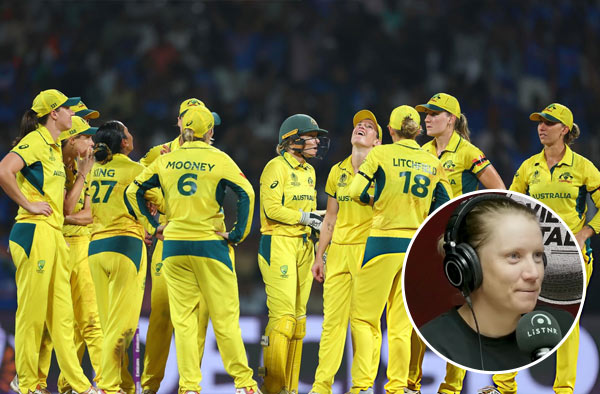
Despite an unbeaten tournament run and a commanding 15-match World Cup streak dating back to 2017, the defending champions fell short against a determined Indian side led by Harmanpreet Kaur.
Australia, who had posted 338 after winning the toss, appeared in control thanks to Phoebe Litchfield’s fluent 119 off 93 balls and Ellyse Perry’s composed 77. Ashleigh Gardner’s late burst of 63 off 45 balls pushed the total towards dominance, yet Healy conceded that it felt slightly under par. “I actually thought it was under-par,” Healy said.
“Ash Gardner played an unbelievable knock to get us back up to that total, but I think we left a few out there. At one point, we were looking at 350-plus when Pez (Perry) and Phoebe (Litchfield) were set. In the semis, that extra 15–20 runs can make a world of difference.”
That difference proved costly as Jemimah Rodrigues, remaining unbeaten on 127* off 134 balls with 14 boundaries, alongside skipper Harmanpreet Kaur (89 off 88 balls), steered India to victory with nine balls to spare. It was the first time Australia had been beaten in a World Cup since India defeated them in 2017. As a result, India sealed their third final appearance.
[embedpress]https://x.com/imfemalecricket/status/1983946898668187954?t=mwYAXJQzJStMPN9fyzgl4g&s=19[/embedpress]
Healy acknowledged that conditions offered few excuses but highlighted subtle shifts under lights. “The red soil at DY Patil doesn’t attract too much dew,” she explained.
“The wicket was a little slower than what we’d been used to, and we probably weren’t quick enough to adapt to the change of pace. It rained a bit, made it slide on more, but we just missed a little with the ball at the back end.” The Australian skipper admitted that Australia “created opportunities” but “weren’t able to capitalise on them,” stressing how narrow margins often define World Cup knockouts.
When quizzed about fielding lapses, Australia’s catching efficiency was recorded at 67 percent. Healy took accountability but offered balance. “I didn’t know that figure. We’ve got a pretty harsh system ourselves. Maybe we dropped a few easy ones, but we also turned half-chances into opportunities other teams might not have reached. Still, catches do win matches, and in the semifinal, that might’ve been handy,” she quipped.
The semifinal evening wasn’t without drama. Healy recalled her own dismissal amid a chaotic moment when stadium lights flickered mid-over. “I had a bad feeling,” she laughed. “The lights came on mid-ball, people were walking in front of the sight screen, it was chaos. I thought, maybe I should’ve waited; if I’d waited one more minute, we’d have gone off. But that’s elite sport, half an inch off and you’re done. Pheebs (Phoebe Litchfield) and Pez (Ellyse Perry) took over from there.”
Australia’s route to the semifinal had been near flawless. They topped the league stage with 13 points from seven games, six wins and one washout, becoming the first team to qualify. Their campaign began with an 89-run win over New Zealand in Indore, followed by victories against Pakistan, India, Bangladesh, England, and South Africa.
Stand-in skipper Tahlia McGrath led successfully when Healy missed two fixtures due to a minor calf injury. At the individual level, Healy tallied 299 runs at a strike rate of 125.10 and an average of 74.75 across five innings, including two centuries, underlining her dominance as one of the tournament’s standout batters.
Still, in her reflective tone on the podcast, Healy didn’t shy away from larger truths. “Maybe between the 38th and 43rd overs with the bat, and another five-over block while bowling, we lost momentum,” she remarked. “Those tiny stretches can swing big games.”
Then came the most poignant admission: “I’ve been open in saying that’s my last ODI World Cup. I’m not rolling around at 39,” she said with a wry smile. “Megan Schutt’s said the same. Ellyse is 35. There’ll be opportunities for younger players to step up. One tournament doesn’t define us, but yeah, it would’ve been nice to have that trophy.”
[embedpress]https://x.com/imfemalecricket/status/1983956990591463477?t=uvBWP1AM7kbHxuWvWlCfmQ&s=19[/embedpress]
Healy also reflected on how the World Cup reminded her of how far the women’s game had come since her early days juggling cricket with shifts at KFC. “People couldn’t believe we had jobs back then,” she laughed. “I was on a $5,000 contract. They made a big deal out of me going from KFC to a World Cup, but hey, I was always going to be a cricketer.”
For Healy, standout memories from the campaign weren’t just personal milestones, like her hundred in the league-stage chase against India, but the collective brilliance around her, “Moon’s hundred against Pakistan, Ash’s hundred against New Zealand, Belsie’s five-for, Kingy’s seven-for, we saw some unforgettable cricket,” she said. “It just sucks that we didn’t finish with medals, but some of those moments will stay with us forever.”
As the dust settles on Australia’s 2025 campaign, Healy’s candid reflections, a blend of honesty, humour, and deep pride, encapsulate the heartbeat of a champion leader passing the torch. Australia may have lost a semifinal, but in Healy’s words, their legacy “isn’t defined by one game, it’s built over years of sustained brilliance.”
(Quotes sourced from Willow Talk Podcast)

Loves all things female cricket