Chess fell to computers in the 1990s. Go followed in 2016. Poker held out longer, and the reason is easy to see once you sit down at a table: you can’t see your opponent’s cards. What’s the right play when it depends on what they might hold, and on what they think you hold? For years, researchers called that kind of uncertainty one of the hardest problems in artificial intelligence.
Then, in just a few years, poker programs went from losing to pros to beating them. The story of Libratus, Pluribus and the solvers that came after is more than a chapter in AI history. It changed how serious players study, whether they play live or on sites like BCPoker, and it’s worth knowing what to take from the machines and what to leave behind.
Why poker was the hard one
In chess both players see the whole board. Everything that matters is out in the open, so the job is calculation. In poker the key information is hidden. You can’t just compute the best move. You have to think in ranges of possible hands, guess how an opponent will read your actions, and mix up your own play so nobody can exploit it.
That last bit is the real headache. If you always bluff in a certain spot, people notice and adapt. A good strategy has to be balanced, which means randomising between actions in the right proportions. Getting a computer to find that balance in a game as big as no-limit hold’em was a serious scientific challenge.
2015: solved, then stumped
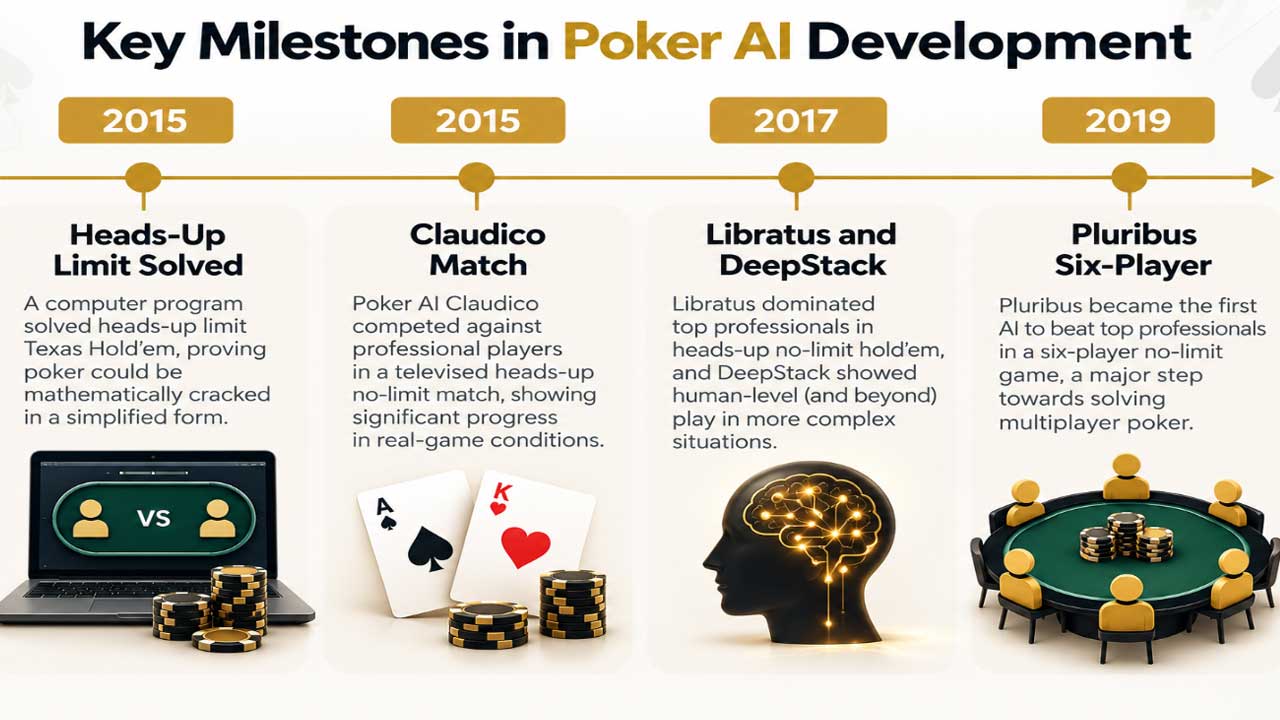
The first milestone came in January 2015, when researchers at the University of Alberta published a paper in Science showing that heads-up limit hold’em had essentially been solved. That’s the simpler version, with fixed bet sizes.
Later the same year the picture got messier. Claudico, a program from Carnegie Mellon University, played professionals at heads-up no-limit hold’em, which is a far larger game. Over 80,000 hands, the humans finished ahead. A useful reminder that no-limit, with its enormous range of possible bet sizes, was a much harder nut to crack.
2017: Libratus beats the heads-up specialists
Two years later Carnegie Mellon’s Tuomas Sandholm and Noam Brown came back with a new program. In January 2017 Libratus played four elite heads-up specialists at the Rivers Casino in Pittsburgh. The match lasted 20 days and 120,000 hands, and the program finished well ahead, beating all four professionals.
Libratus didn’t just memorise lines. It first played against itself over a huge number of simulated hands to build a strategy blueprint, then refined its decisions during live play. Around the same time another program, DeepStack from the University of Alberta and partner institutions, also reported beating professionals at heads-up no-limit.
2019: six players, one winner
Heads-up is only a slice of poker. Most games have several opponents, and multiplayer games are much harder to analyse. In July 2019, Carnegie Mellon and Facebook AI published a paper in Science about Pluribus, a program that beat professionals at six-player no-limit hold’em.
The tests were carefully built. In one, a single professional faced five copies of Pluribus. The humans included Darren Elias, who holds the record for the most World Poker Tour titles, and Chris Ferguson, a six-time World Series of Poker champion. In another, Pluribus sat with five human professionals over 10,000 hands. Both times, the program came out ahead.
The researchers also pointed out how modest the computing demands were compared with earlier milestones, which made the result even more striking.
What the bots did that humans didn’t
The interesting part isn’t who won. It’s how the programs played differently, and a few lessons made their way into the wider poker world.
Mixed strategies matter. Elias said the program’s biggest strength was its use of mixed strategies. Human players try to do the same thing, just far less precisely.
Unpopular lines can work. Pluribus made donk bets, leading into the previous aggressor, much more often than the pros it beat. Most humans avoid that play. The program used it profitably.
Strong play is balanced. Both programs built strategies that weren’t easy to predict, which is exactly what people try to achieve when they balance bluffs and value bets.
Bet sizing is a tool. Libratus used a wide range of sizes, including overbets above the pot, in spots where most humans stick to a couple of standard sizes.
From research lab to your study routine
Commercial solvers like PioSolver showed up in the mid-2010s, built on the same family of algorithms, counterfactual regret minimisation, that powered the research bots. Libratus and Pluribus proved those methods could handle the real game, and public tools turned them into part of everyday study. You enter a specific situation and the solver gives you a computed strategy for it, including how often to bet, check or fold with each hand.
Within a few years, solver study went from a niche habit to standard preparation. Training sites built drills on top of solver output, and talking about hands in terms of frequencies became normal. The game’s vocabulary shifted, and so did what people expect from a serious player.
What solvers can’t do for you
For all their power, they have limits that matter to most players.
They assume a strong opponent. A solver’s output describes how to play against someone who also plays optimally. A lot of opponents, especially at lower stakes, make predictable mistakes that a more exploitative approach can punish.
They can’t read the table. Timing, sizing habits and how one particular person behaves aren’t part of a solver’s world.
They don’t explain themselves. A solution shows what to do, not always why. Understanding is still your job.
Using one mid-hand can get your account closed. Real-time assistance breaks the rules of the major poker sites, and that applies to mobile play too, so solvers belong in study sessions only.
Using the lessons wisely
The sensible approach is to treat computer strategies as a reference point, then adjust. Learn the principles: why a hand mixes between actions, why certain sizes show up, which spots are clear and which are close. Then apply that thinking to the people you actually play against, whether that’s your home game or the tables at BC Poker.
Players who combine solver study with hand review and honest reflection tend to improve faster than those who copy outputs without understanding them.
What changed
Poker went from a game thought too uncertain for machines to a testing ground for new algorithms in about four years. For players, the lasting effect is a shared vocabulary of ranges, frequencies and balance, plus a way to check your own instincts against a computed baseline.

Loves all things female cricket