The MI Junior Rising Stars League (Girls) 2026 in Nagpur, now in its 6th edition, is quietly becoming one of the most important talent nurseries in Indian women’s cricket, and this season belongs, so far, to an 11-year-old batting all-rounder who grew up on the side of a ground. Team A, led by skipper Janvi Bishnoi, has asserted clear dominance over Team B, captained by Akanksha Krishnarao Bari, winning both their clashes by 8 wickets and 9 wickets respectively.
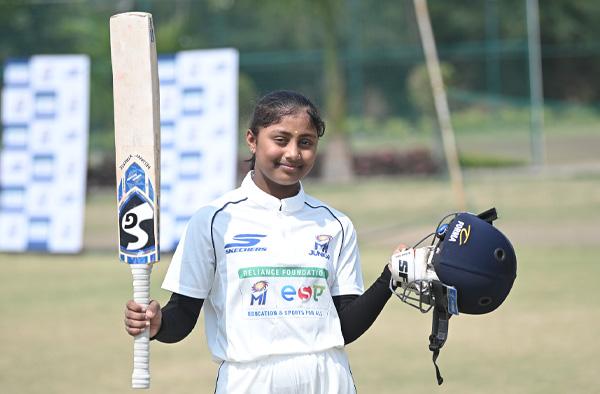
At the heart of that superiority stands left-handed opener Gunjan Suryabhan Taywade, the tournament’s leading run-scorer and one of the clearest signs that the MI Juniors ecosystem, after a successful edition in Mumbai, this year, where Modern English School (Chembur) beat Parag English School in the final by 4 wickets, is already on it’s way to shaping the next generation of Indian women cricketers.
A statement season for Team A
In Nagpur, Team A have set the early benchmark. Twice they have faced Team B, and twice they have chased with authority. The first win came by 8 wickets; the second, even more emphatically, by 9 wickets, underlining a side that knows its roles and trusts its top order. Skipper Janvi Bishnoi has marshalled her resources with a calm, assured presence, while Akanksha Krishnarao Bari’s Team B, despite two heavy defeats, has tested them in patches and ensured the contests retain a competitive edge.
The defining performance of the league so far arrived on 18 March 2026, when Team A were set a target of 112. Chasing in youth cricket can often expose nerves, but that day it only exposed the gap between one young batter and the rest.
Gunjan’s 73 (39): an innings that changed the tone
Opening the innings alongside Tharisha Nandkishor Karwade, who ground her way to 7 off 25 balls, Gunjan Suryabhan Taywade produced a knock that would stand out even at the senior level: 73 from just 39 balls with 12 boundaries and 1 maximum, scored at a strike rate of 187.18. Team A romped home by 8 wickets with 49 balls to spare, a demolition that effectively turned a potentially tricky chase into a personalised batting exhibition.
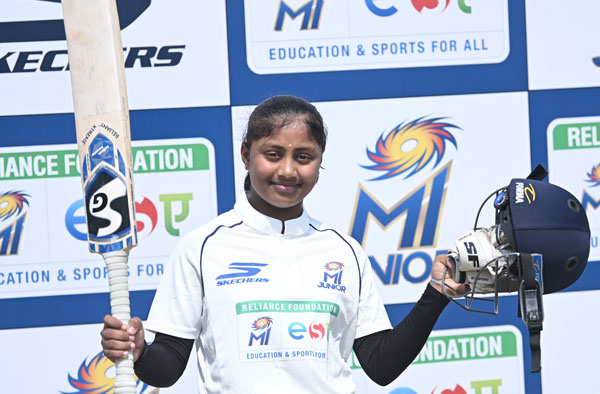
Her innings had layers: the intent to dominate, the clarity of zones, and the composure to play percentage cricket even while scoring at high speed. In a chase of 112, she refused to get dragged into the tempo of a low target, instead setting her own rhythm. It was little surprise that she walked away with the Player of the Match award, but the accolade didn’t quite capture how decisively she had controlled the game from the first over.
Across the ongoing edition, Gunjan is now the leading run-scorer, with 96 runs at a strike rate of 171.43 and an average of 96 from two innings with the bat. Those numbers, at this level, are less about volume and more about dominance. She looks like a player with a lot of time on her hands while at the crease.
A true all-rounder in the making
Gunjan’s impact is not limited to batting. With the ball, she has already picked up a couple of wickets in the tournament at an average of 3 and a remarkable economy rate of 2.25 across two innings. That economy suggests not just wicket-taking ability but control; she dries up runs at an age when most young bowlers are still fighting their action, their rhythm, and their nerves.
She describes herself as a batting all-rounder, but her bowling is already impactful. She also won the Player of the Match award for her bowling, delivering 3 wickets and a maiden over, an unusual script for a player whose batting numbers tend to grab the headlines. “I am a batting all-rounder, but I bowl as well,” she says with simple confidence, but the combination of these skills is exactly what makes her such an exciting prospect.
She represents Shri Rajendra High School in Under-15 Inter-school Cricket. She has scored 209 runs at a strike rate of 177.12 in four innings with the bat for her side, ending as the leading run-scorer for her school. Besides her exploits with the bat, she also picked up 4 wickets at an average of 1.5 and an economy of 1.64 in a couple of innings with the ball for her side in the tournament.
View this post on Instagram
Her school not only finished at the top of the points table with 6 points from 3 games, finishing as the only unbeaten team in the league stages. But, Shri Rajendra High School were also crowned as the champions of the tournament under the leadership of Janvee Radheshyam Bishnoi, as they defeated St Joseph Convent High School in the final by 7 wickets chasing a total of 69, wrapping the chase inside nine overs to clinch the championship title. She was also awarded the Player of the Match for her match-defining spell (3-1-4-3) with the ball, along with her cameo (10* off 5 balls) to seal the run chase in style.
From the boundary rope to centre stage
The story behind Gunjan’s rise is rooted in the red soil and white boundary lines of the grounds she has known since infancy. She is the daughter of groundsman Suryabhan Taywade, who prepares wickets at the Citi Gymkhana Ground. Her father’s job is to provide balanced wickets where players can perform, improve, and build careers. Gunjan’s dream is to be one of those players.
“I am from Madhya Pradesh,” she explains. “I study at Shri Rajendra Indira High School. I am 11 years old. I was born on 29 May 2014, and I am in Class 6. In my family, there is my mom, dad, uncle and aunt, younger cousin and my grandmother. It is a joint family, and cricket is woven into its routine. My dad and my uncle both work in ground marking. They make wickets,” she says, as if talking about something perfectly ordinary, though the significance is much more.
Gunjan has been around grounds longer than most cricketers have held a bat properly. “I started playing at a very early age. I used to visit the grounds with my father since I was 6 months old. I used to come with my dad and uncle. We used to stay on the ground, so I grew up watching them play.” The pitch, quite literally, has been her playground and her classroom.
School beginnings and the coaching ecosystem
Her first formal step into cricket came through her school. “The first-ever cricket match I played was with Shri Rajendra School,” she says. Interestingly, structured practice there has been sporadic. “Do you practice regularly at Shri Rajendra?” she is asked. “No, we mostly practice during matches,” she admits.
The real backbone of her development has been her coaching circle. “My coach is Deepak Wajelwar, sir. He teaches batting, bowling and fielding to students from 4–6 PM. Priyanka ma’am handles fitness between 7–8 PM, and Gyani sir teaches batting 8–10 PM.” That schedule speaks of discipline and of an ecosystem that is giving young girls professional-level contact hours at a crucial age.
“Do you practice every day?” she is asked. “Yes. Even on Sundays, Gyani sir comes at 4 PM, and we practice in the morning with friends as well.” The volume of cricket she plays and trains for explains the assurance with which she handles pressure in tournaments like MI Junior, especially in Nagpur’s current edition.
Support extends beyond coaches. “Does anyone in your school support you?” “Yes, Mr Tushar, Mr Neeraj and Mr Shekhar support me in both batting and bowling.” For a young player, having teachers actively invested in both disciplines matters; it normalises ambition and gives her permission to see herself not just as a participant, but as a cricketer.
Heroes, role models, and a lefty’s elegance
Gunjan Taywade’s cricketing influences reflect a mix of the Indian men’s and women’s games. “Yes, I watch Smriti Mandhana, Virat Kohli and Ishan Kishan,” she says. The reasoning is straightforward and revealing. “Smriti Mandhana and Ishan Kishan are left-handed, and I am also a lefty. Their batting is very good. Virat Kohli’s cover drives are classic.”
There is also a clear element of mimicry in learning. “Do you try to practice like them?” “Yes, I practice like them,” she replies. For a developing left-hander, modelling her game on Mandhana and Kishan while absorbing Kohli’s technical elegance provides a compelling blend of flair and structure. It shows in the way she scores heavily yet maintains control, as she did in that 73 (39) in the Nagpur league.
Proven pedigree: performances beyond Nagpur
This is Gunjan’s first season in MI Junior. “This is my first year playing in MI Junior,” she says, but her track record suggests she arrived with serious form behind her. “This season, I have won 3 Man of the Match awards, 1 Player of the Tournament award, and 1 Best Batter award. Last year also, I won many medals and trophies, including one in Gondia.”
Her numbers from a previous tournament, where she captained, are staggering: “I was the captain in one of the tournaments where I scored 101 in the first match, 50 in the second, 173 in the third and 21 in the fourth. I also won Best Batter in the U-12 tournament.” These are not isolated flashes; they form a pattern of consistency and dominance across formats, venues and age-groups.
The Gondia tournament adds a layer of resilience to her story. “In the Gondia tournament, I was not feeling well and was potentially out of the team. However, the team needed me, and they sent a car just to pick me up so I could come and play. Then we started winning a lot of matches, unfortunately, we fell short in the knockouts, so we couldn’t go ahead.” The details underline how central she already is to her team’s plans: they reorganised logistics around her availability, and her presence swung momentum in their favour.
MI Juniors: from Mumbai to Nagpur
This Nagpur edition of the MI Junior Rising Stars League (Girls) follows the blueprint of the recently concluded MI Juniors tournament in Mumbai, held in March this year. There, Modern English School (Chembur) were crowned champions after defeating Parag English School in the final by 4 wickets, a result that highlighted the depth of school-level cricket in the city.
That Mumbai success now flows into Nagpur, creating a wider MI Juniors footprint that links two strong centres of cricket. The Nagpur leg, with its 6th edition underway, is not just mirroring Mumbai but adding its own narrative, one that currently revolves around Janvi Bishnoi’s clinical leadership, Akanksha Bari’s battling side, and Gunjan’s meteoric rise.
A season of Learning and Leadership
Even in a season where she has become the leading run-scorer and an effective bowler, Gunjan still frames much of her progress in terms of learning. “What have you learned from these matches?” she is asked. “I have learned by watching other players. One player, Eliza Anthony from St. Joseph Convent High School, has very good leg spin; no one can play it easily. Another player, Latika, is also very good. They both play very well.”
Her awareness of players from the opposition, like Eliza and Latika, signals a player who studies the game, not just her own numbers. When she speaks about her “usual batting positions. “Opening and one-down,” it is with the matter-of-fact tone of someone who understands her role at the top of the order and thrives in it.
Her current MI Junior season encapsulates her adaptability. “I played 4 matches. I batted in 3 of them. In the first two matches, I opened and scored 143 not out and 33 not out. In the third match, I didn’t bat, and today in the final, I scored not out 10 runs.” These scores show a player comfortable anchoring, accelerating, and finishing, depending on what the team requires.
Family, sacrifice, and a shared dream
Behind the tidy scores and awards stands a family that has done the unseen work of nurturing a dream. “My parents have supported me a lot. They have worked very hard for me,” Gunjan says. “Earlier, when I didn’t play well and got out early, they still encouraged me. Now that I am scoring runs, I feel happy. They always supported me.”
Her father, a groundsman tasked with preparing pitches that allow others to shine, now watches his daughter dominate on the very kind of surfaces he has dedicated his life to creating. Her message to him is simple but powerful. “They have told me that they couldn’t play, but I can, so I should play and make a name for the family.”
That sentiment blends perfectly with her own ambition. Gunjan’s dream is not vague or distant; it is sharply defined. She wants to do well, improve her game, and one day play for the senior Indian women’s cricket team and become one of the crucial contributors in terms of performance for the country. When asked directly, she puts it in her own words: “I want to play for India and make my place in the playing XI.”
Why Gunjan Taywade and MI Juniors matter?
The MI Junior Rising Stars League (Girls) 2026 in Nagpur is more than a school-level competition; it is a structured pathway where stories like Gunjan’s find shape and direction. Team A’s twin wins over Team B by 8 wickets and 9 wickets, powered by performances like Gunjan’s 73 (39 balls) in a chase of 112 and backed by her all-round tally of 96 runs at a strike rate of 171.43, an average of 96, and bowling figures that include 2 wickets at an average of 3 and an economy of 2.25, showcase the standard of cricket on offer.
At 11, from a joint family in Madhya Pradesh, studying at Shri Rajendra Indira High School and training under coaches like Deepak Wajelwar, Priyanka ma’am and Gyani sir, Gunjan has already compiled a portfolio that includes multiple Man of the Match awards, a Player of the Tournament, a Best Batter trophy, centuries and big scores as captain, and decisive bowling spells in finals. Her journey from watching her father mark pitches to owning those same 22 yards captures the essence of what MI Juniors is trying to build: a bridge between passion and opportunity.
If the 6th edition in Nagpur is any indication, the MI Junior Rising Stars League is not just unearthing talent; it is shaping future Indian players. And somewhere on a carefully rolled Citi Gymkhana wicket, a groundsman’s daughter is already batting as if she fully intends to be one of them.

I am Yash Tailor, and I believe work should be driven by passion. Therefore, after completing my Engineering, I chose to work in the Cricket industry, my passion. My goal is to reach a stage where I truly enjoy what I do and give my best to every task with energy and purpose.