The race for semi-final spots in the 13th edition of the ICC Women’s ODI World Cup 2025 has intensified, and India’s campaign, under the leadership of Harmanpreet Kaur, is at a defining stage. With only 4 points from four matches but a healthy net run rate of +0.682, the hosts are currently placed third in the standings.
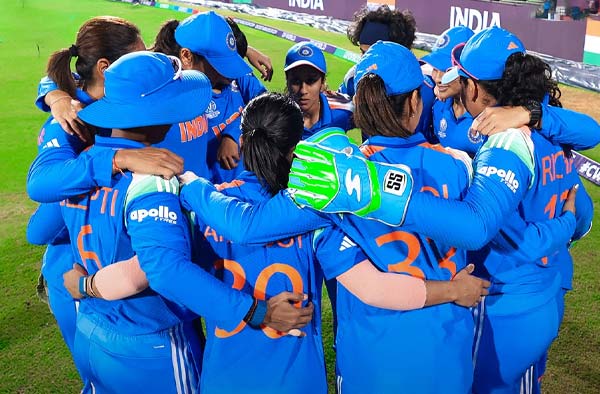
Their journey has been a mix of commanding wins against Sri Lanka and Pakistan in the opening encounters, and hard-fought losses against South Africa and Australia in back-to-back fixtures. Now, with three critical group-stage matches left against England, New Zealand, and Bangladesh, India’s qualification scenario is clear: win all remaining games to ensure control over their semi-final destiny.
India opened their campaign in style on 30th September 2025 at the Barsapara Cricket Stadium, Guwahati, defeating Sri Lanka, led by Chamari Athapaththu, by 59 runs. This momentum continued into their second match on 5th October at the R Premadasa Stadium, Colombo, where they outclassed Pakistan by 88 runs.
However, Visakhapatnam proved to be a turning point; a narrow 3-wicket loss to South Africa on 9th October was followed by another close 3-wicket defeat to Australia on 12th October, despite a high-quality contest that matched pre-match expectations.
Currently, India is one of only three teams in the tournament to maintain a positive net run rate, a statistic that reflects both their batting depth and bowling resilience. Yet, the standings leave no room for complacency, as a slip in the upcoming fixtures could open the door for rivals.
Batting Lineup Showing Spark:
India’s batting core has been productive, offering encouraging signs for the must-win matches ahead:
Pratika Rawal – 180 runs in four innings, averaging 45, and the team’s leading run-getter.
Richa Ghosh – 163 runs at 54.33, anchoring innings with composure under pressure.
Smriti Mandhana – 134 runs at 33.50, providing crucial starts at the top. She returned to her fluent best in India’s previous game against Australia.
Harleen Deol – 145 runs at 36.25, stabilising the middle order.
While the focus often leans to batting, India’s bowling attack, spearheaded by Deepti Sharma, Sneh Rana, and Kranti Gaud, has repeatedly broken partnerships and applied scoreboard pressure. Amanjot Kaur has displayed impressive all-round capabilities so far. Their ability to strike across different phases of the innings will be vital against upcoming opponents, especially England’s unbeaten batting force led by Nat Sciver-Brunt.
India’s next match, arguably their toughest yet, comes on 19th October at the Holkar Stadium, Indore, against unbeaten England. Four days later, on 23rd October, they meet New Zealand at DY Patil Stadium, Navi Mumbai. The group stage finale on 26th October, against Bangladesh, also at DY Patil Stadium, falls within the tournament’s only double-header day and could well be the game that seals or shatters India’s semi-final bid.
Given England’s and Australia’s current unbeaten streaks, India must treat every remaining fixture as a knockout to avoid relying on other results. Any slip will likely bring net run rate or other teams’ performances into play, scenarios that are far less under their control.
The Harmanpreet Kaur-led side has demonstrated they can compete with the best, even in defeat, which is a promising sign heading into decisive fixturesThe Harmanpreet Kaur-led side has demonstrated they can compete with the best, even in defeat, which is a promising sign heading into decisive fixtures. With multiple in-form batters, versatile bowling options, and home support boosting morale, India retains a realistic chance of reaching their third Women’s ODI World Cup final, but only if they maintain winning momentum from here on in. Each game from Indore to Navi Mumbai will not just be a contest for points; it will be a test of nerve, adaptability, and belief.

Loves all things female cricket