From Village Squares to Stake Live Tables: The History of Teen Patti and Andar Bahar
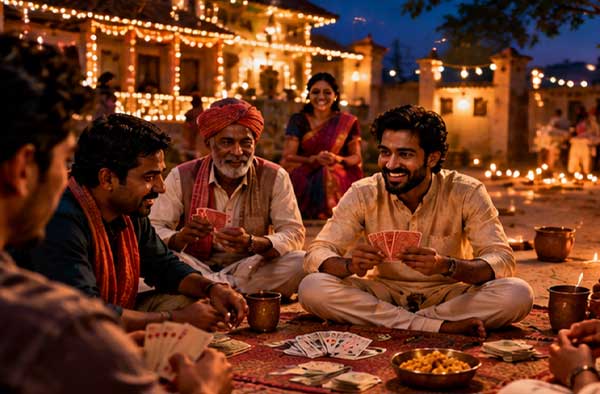
Ask an Indian family about card nights and someone will bring up Teen Patti or Andar Bahar, usually with a story about an uncle who never folded. People dealt both games on courtyard floors, at weddings and deep into Diwali night, decades before smartphones. Tracing that journey also shows how a festive pastime grew into India’s best-known Stake game.
Teen Patti: An Indian Favourite with British Roots
Teen Patti means “three cards” in Hindi. It descends from Three Card Brag, a British game that itself grew out of 16th-century Primero, and during colonial rule it spread across the subcontinent, picking up local names, slang and rituals along the way.
The basics take five minutes. Everyone puts a fixed amount, the boot, into the pot and gets three cards. You then play blind, without looking, or seen, after a peek. Blind players bet half as much per turn, which is why a nervy player holding rubbish can still bully the table. The vocabulary is local too: a bet is a chaal, folding is packing, and a show settles the hand when two players remain.
How Teen Patti Hands Rank
Hands rank like this, strongest first.
| Rank | Hand | What it looks like |
|---|---|---|
| 1 | Trail | Three cards of the same rank |
| 2 | Pure Sequence | Three consecutive cards of the same suit |
| 3 | Sequence | Three consecutive cards in mixed suits |
| 4 | Colour | Three cards of one suit, not in order |
| 5 | Pair | Two cards of the same rank |
| 6 | High Card | None of the above |
Poker players trip over this one. A sequence beats a colour (a flush), because with only three cards, a run is harder to hit.
Diwali and the Tradition of Festive Card Nights
So why Diwali? Legend says Goddess Parvati played dice with Lord Shiva on Diwali night and declared that anyone who gambled that night would prosper all year. Card parties slowly became part of the festival in many homes across North and West India, and Teen Patti nearly always won the vote.
Bollywood picked it up as well. In the 2010 thriller Teen Patti, Amitabh Bachchan plays a mathematician who tries to beat the game with probability theory, with Ben Kingsley in the cast. Whatever you think of the film, its premise only works because audiences already knew the game.
Andar Bahar: South India’s Game of Pure Luck
Andar Bahar, or Katti in parts of the country, is widely said to have started in Bengaluru, Karnataka, where people have played it for centuries. The name means “inside-outside”, after the two piles the dealer builds.
You can’t really play it badly. There are no rankings to learn and nobody to bluff. One deck, one question: which pile gets the matching card first? That’s why fairground crowds loved it, and why strangers could drop into a round without asking for the rules.
How a Round of Andar Bahar Plays Out
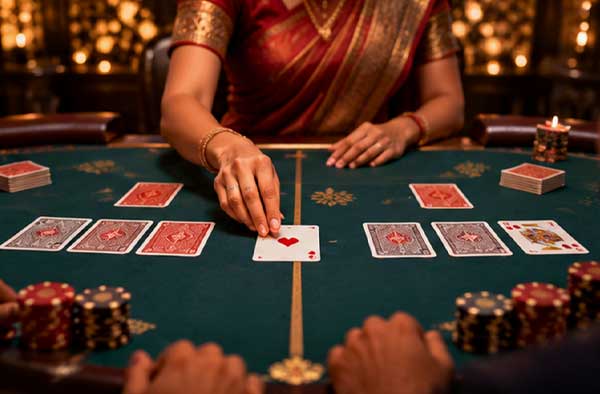
- The dealer shuffles a standard 52-card deck and turns one card face up in the centre. This is the joker, or game card.
- Players bet on Andar, the inside pile, or Bahar, the outside one.
- The dealer deals one card at a time, alternating between the piles. House rules decide which pile gets the first card.
- Dealing continues until a card matching the joker’s rank turns up.
- The pile that receives it wins, and bets on that side are paid.
Teen Patti vs Andar Bahar: Side-by-Side Comparison
Same deck, shared roots, a completely different feel at the table.
| Feature | Teen Patti | Andar Bahar |
|---|---|---|
| Origin | Grew out of British Three Card Brag | Widely traced to Bengaluru, Karnataka |
| Deck | Standard 52 cards | Standard 52 cards |
| Players | Usually 3 to 6, competing against each other | Any number, all betting on the same deal |
| Skill vs luck | Mix of judgement, bluffing and chance | Pure chance |
| Hand rankings | Yes, from Trail down to High Card | None, only the matching rank counts |
| Main decision | Play blind or seen, raise, fold or ask for a show | Back Andar or Bahar |
| Round length | Several betting rounds | Ends as soon as a matching card appears |
| Popular twists | Muflis, AK47, Joker | Side bets on the number of cards dealt |
From Card Tables to Mobile Screens and Stake’s Live Lobby
Cheap smartphones and data in the 2010s changed both games. Social apps such as Octro’s Teen Patti put a table in your pocket at 3 am, whether you wanted friends or strangers from another state.
Live dealer studios went further. Ezugi, which Evolution bought in 2018, built streamed Andar Bahar and Teen Patti tables with real dealers. International platforms such as Stake now carry both games in their live lobbies, with tables from studios including Evolution, so a human still deals the cards even when you’re watching on a phone.
Online play also made fiddly variants workable. In Muflis, the lowest hand wins. In AK47, aces, kings, fours and sevens are all wild. Joker versions pick a random wild card each deal, which inflates hands wildly. Try tracking that at a crowded Diwali table after midnight, and you’ll see why these spread online first.
What India’s 2025 Gaming Law Changed for Platforms Like Stake

The Promotion and Regulation of Online Gaming Act received presidential assent on 22 August 2025 and redrew the rules for online card games in India. If you play either game, five points matter:
- Real-money play is banned. Offering or facilitating online money games is prohibited, and that covers real-money versions of both games on any platform, Stake included.
- Advertising is off-limits too. Promoting online money games through any media can bring a fine of up to ₹50 lakh or two years in prison.
- Payments are blocked. Financial transactions linked to online money gaming services aren’t allowed.
- Operators face the toughest penalties. Running such a service can cost up to ₹1 crore or three years in prison, and repeat offenders face harsher terms.
- Social games stay legal. Games played purely for fun, with no money involved, are explicitly permitted, and so are registered e-sports.
Free-to-play and social versions remain open to Indian players. Both games have already survived bigger upheavals than this one, from colonial-era card rooms to smartphone apps.
Conclusion: Why These Games Have Lasted
Why do they last? Because they scratch different itches. Teen Patti rewards nerve and the knack of reading whoever sits opposite you. Andar Bahar is quick and transparent, and you can explain it in a single sentence. Both carry memories of festivals and noisy family evenings, which no new release can fake. I’d happily bet on both still being dealt, in one form or another, decades from now.

Loves all things female cricket