Hours before the first drops of rain ever touched Navi Mumbai, the streets around the DY Patil Sports Academy had already begun to pulse with colour, song, and anticipation. It was barely mid-morning, yet fans — many draped in blue, waving flags, and clutching tickets like treasure — had formed an unbroken line from the team hotel to the main gate. The final was scheduled for 3 PM, but by 10 AM the mood felt like a festival that could no longer wait for its script to begin.
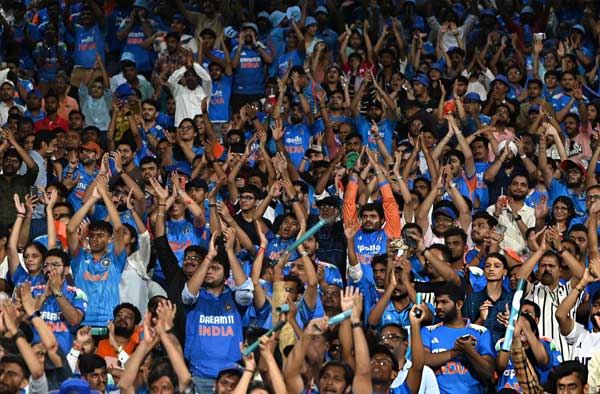
For most of these supporters, this was not just another World Cup match. This was the first Women’s ODI World Cup final on Indian soil with the hosts in contention — a moment generation of fans had waited to live, not just watch. The “Sold Out” board at the entrance didn’t merely confirm a full house; it confirmed a shift in Indian sporting culture. The women’s team wasn’t just being supported — it was being celebrated.
[embedpress]https://x.com/imfemalecricket/status/1984938336004268354?t=C-dBQPCbCmv3Jblvry8Lww&s=19[/embedpress]
The DY Patil Stadium is no stranger to such scenes. When India hosted Australia in the five-match T20I series in December 2022, the opening game at this very venue drew a crowd so large that entry gates had to be thrown open for free to accommodate the surge. A year later, in the 2023-24 bilateral series between the same teams, history repeated itself — another sold-out audience, another electric coat of blue in the stands. Women’s cricket in India had stopped asking for space. It had started filling stadiums.
And yet, November 2nd felt different — louder, heavier, more emotional. This time, the stakes were not about beating Australia or setting attendance records. This time, it was a world title on the line.
[embedpress]https://x.com/imfemalecricket/status/1984925850224275776?t=C-dBQPCbCmv3Jblvry8Lww&s=19[/embedpress]
Through the tournament, India’s fixtures consistently drew the biggest turnouts, but the final dwarfed everything before it. If every ticket holder braved the weather, the attendance was set to touch 45,000, a figure that would make it the most-watched Women’s ODI World Cup match in history.
South Africa, playing their first-ever Women’s ODI World Cup final, arrived as a team sculpted by years of near-misses. They topped the group phase with five wins in seven matches, losing only to Australia and England. Their semi-final performance — a ruthless 125-run win over England — didn’t just earn them a ticket to Navi Mumbai. It exorcised the ghosts of 2017 and 2022.
India, in contrast, wandered into the knockouts through storm and skepticism. Three wins, one no-result, and endless questions. Until they produced the kind of semi-final that became folklore: a 339-run chase against Australia, accomplished with five balls and five wickets to spare, ending the world champions’ 15-match unbeaten streak. Navi Mumbai didn’t just witness it — it shook from it.
[embedpress]https://x.com/imfemalecricket/status/1984895907314483713?t=C-dBQPCbCmv3Jblvry8Lww&s=19[/embedpress]
So now, two nations stood a match away from their first world title. One team chasing redemption, the other chasing destiny. One city holding its breath, one stadium wrapped in blue, and one sport once again surrendering to the unpredictable hand of the monsoon drifting in from the Arabian Sea.
The final may yet belong to the team that handles pressure best — but before a ball is bowled, the crowd has already won. They came early. They came loud. They came loyal. They came as a sea of blue, proving that in India, women’s cricket is no longer a movement in progress.

Loves all things female cricket