Australia’s hopes for a record World Cup title were dashed at the DY Patil Stadium, Navi Mumbai, on 30th October 2025, as Alyssa Healy’s side slipped to a dramatic defeat against India in the 2nd semi-final of the ICC Women’s ODI World Cup.
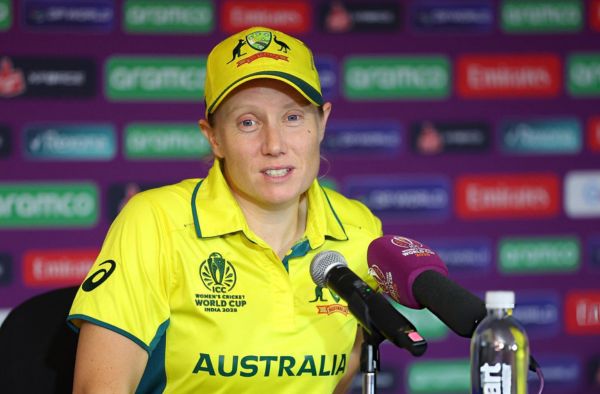
In the post-match press conference, skipper Alyssa Healy delivered a measured yet candid assessment, blending poignant reflections, pointed stats, and heartfelt insights on her team’s performance and the wider impact of a new champion emerging in women’s cricket.
As emotions ran high in the closing stages, Healy couldn’t hide her disappointment: “Ultimately, we just weren’t sharp enough today, in all three facets, to give ourselves the opportunity to win that semi-final. We hung in there, created opportunities, and just let ourselves down.” The final three overs were a microcosm of missed chances, with catch opportunities and misfields proving costly. Healy graciously credited India for their clinical chase but admitted the hurt stemmed from Australia’s own lack of ruthlessness, “There’s a little bit of an element of we let ourselves down a little bit.”
Despite putting up a mammoth 338, the highest-ever semi-final total, courtesy of Phoebe Litchfield’s blazing 119, twin fifties from Ellyse Perry and Ashleigh Gardner, the mood in the dugout remained urgent. Healy explained, “We did really well to get a score like that, but we could’ve been better and got a few more, ironically. At the halfway mark, we knew we had a big job to do with the ball.” With the pitch offering assistance, Australia failed to capitalise on their chances, as Healy conceded, “We dished up a little bit too much junk to hit at times and probably didn’t capitalise on the opportunities we did create. Feels a little bit un-Australian to not be as clinical as what we normally are.”
Dropped catches haunted Australia, shifting momentum decisively towards India. Healy candidly admitted, “It definitely changed the course of the match. Wasn’t semi-final pressure, maybe just concentration, but to create those opportunities and not capitalise, that was disappointing.” As Jemimah Rodrigues powered her way to a record-breaking unbeaten 127* and Harmanpreet Kaur’s calculated 89 orchestrated a record chase, Australia’s tenuous grip on the contest slipped away with every missed chance and unconverted opportunity.
Australia’s run to the semi-final was studded with highlights, not least their 15-match unbeaten streak stretching back to Derby 2017. Healy acknowledged the collective effort: “We were playing some unbelievable cricket. We had different contributions right throughout. The team contributed equally, and that put us in a nice place heading into this final’s series. There are huge positives, this next four-year cycle is going to be really exciting, especially for some of the younger players to get greater opportunities in this side.”
When asked about Jemimah Rodrigues’ match-winning effort, Healy praised her mental resilience and awareness. “She played really well tonight. We gave her a couple of opportunities, which didn’t help us, but her mental resilience out there to get her team over the line was exemplary, so full credit to her.” The turning point, Healy felt, came in the last five overs, with both teams still in contention and the pressure mounting. “Funny things happen in games of cricket when it gets tight like that.
With India set to face South Africa (who themselves scripted history with a record semi-final win over England), Healy highlighted the wider significance: “I’ve heard many people say this was the closest tournament they’ve ever played when it comes to ODI World Cups, and I tend to agree. Rain played its part, but there were genuinely 8 teams in finals contention. Seeing a new winner will do wonders for the global game. The support here in India has been incredible, and it’s special for them to play at home in a World Cup final.”
After their previous defeat in the tournament, in Derby in 2017 (before the 2nd semi-final in Navi Mumbai), Australia responded with a 15-match unbeaten streak in the tournament, before suffering another defeat against India in a semi-final in the ongoing edition. “It’s an opportunity for players to experience high-pressure situations, which will do wonders for our group.” As Australia heads into a new World Cup cycle, Healy emphasised the value of more ODI cricket and bilateral series, believing it is essential to keep the competition fierce and provide the next generation a platform to shine.
One standout positive was Phoebe Litchfield, whose 119 came at just 22 years and 195 days old, making her the youngest century-maker in a Women’s World Cup knockout game. Healy beamed, “She’s a natural free-flowing player, and today she really cashed in, sort of what happens at the end of a cycle, you see the next generation come through and play differently. Her fielding and energy drive standards for the group.”
As Australia’s streak ended, Healy insisted that the lessons learned “under pressure, in little moments, will make us better.” The defeat, though bitter, also marks a renewal for a team brimming with promise, as a new chapter begins in women’s cricket, and all eyes turn to a historic final between India and South Africa, guaranteeing the rise of a new champion and the promise of a fiercely competitive future.

Loves all things female cricket