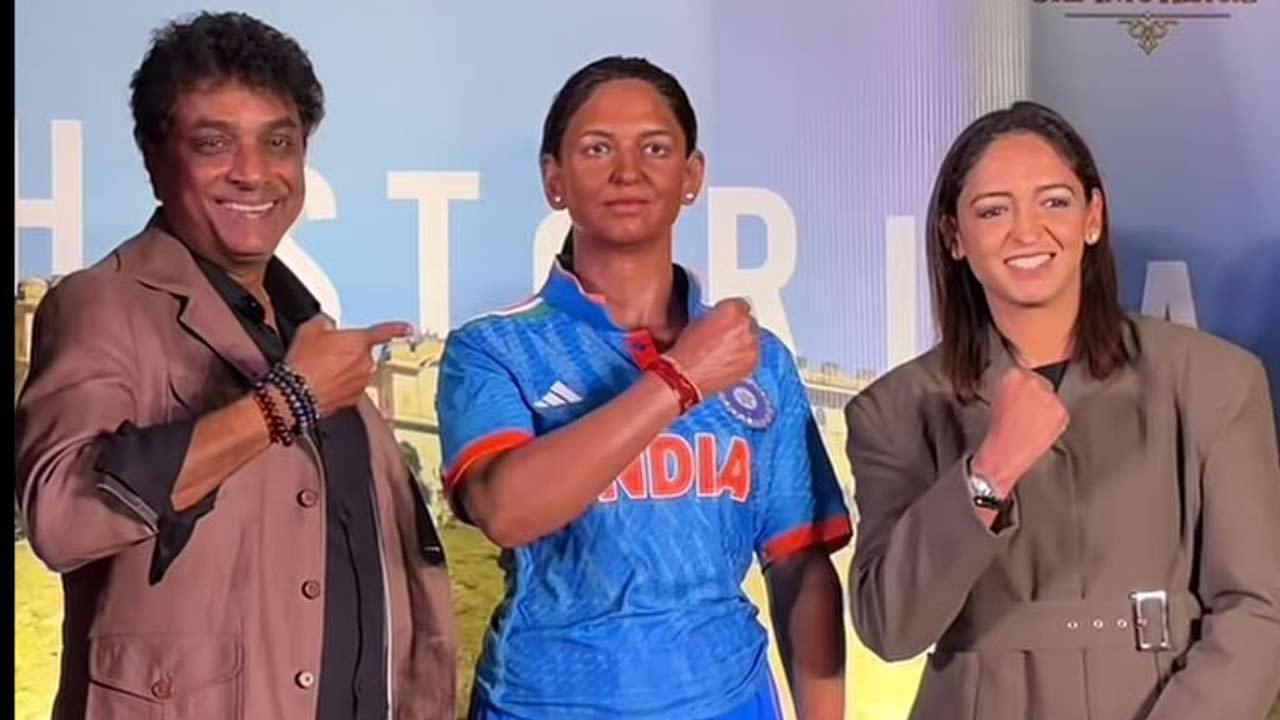
Harmanpreet Kaur’s wax statue being unveiled in Jaipur is more than a personal honour for India’s former women’s cricket captain. Placed alongside the likes of Sachin Tendulkar and MS Dhoni, it is a visible sign that women’s cricket is no longer being treated as a footnote in Indian sport, but as a movement capable of reshaping the country’s cricketing imagination.
A Landmark Moment for Women’s Cricket
For Harmanpreet, the recognition arrived a year after the most defining chapter of her captaincy. Under head coach Amol Muzumdar, India lifted their maiden senior-level ICC title by defeating Laura Wolvaardt’s South Africa by 52 runs in the final of the 13th ICC Women’s ODI World Cup at the DY Patil Stadium in Navi Mumbai on 2 November 2025. The tournament, hosted by India and partly in Sri Lanka from 30 September to 2 November 2025, ended a long wait for Indian women’s cricket.
“For me, it was a very big achievement. I think it was the hard work of so many years, and there was always just one dream: to make India win the World Cup. And when we won it, a very big dream came true, and I’m sure that in the coming times, we will keep winning trophies like this,” Harmanpreet said in Jaipur.
That triumph did not merely complete a career ambition; it altered the emotional contract between Indian women cricketers and their audience. For years, India had produced stars, memorable innings and near-misses, but the absence of an ICC trophy at the senior level had become a persistent narrative burden. By crossing that line, Harmanpreet’s side gave the next generation something more valuable than inspiration: proof of what’s possible.
Following the Footsteps of 1983
The captain herself drew the comparison with India’s 1983 men’s World Cup victory, a moment that transformed cricket’s place in the national consciousness. “As we saw when India won the World Cup for the first time in ’83, after that the whole landscape of men’s cricket changed. Similarly, right now the landscape of women’s cricket seems to be changing, and I’m sure this is just the beginning; in the coming times, we will do even better,” she said.
The evidence of that changing landscape is already visible in India’s recent cricketing calendar. Soon after the 10th ICC Women’s T20 World Cup, hosted by England and Wales from 12 June to 5 July 2026, India returned to Lord’s for a historic first women’s Test at the venue, against Nat Sciver-Brunt’s England from 10 to 13 July 2026.
It became a statement series. India, inserted by England after losing the toss, made 285 in 74.5 overs in the first innings before being bowled out. England then collapsed for 170 in 59.1 overs. India declared at 341 for 7 in 86.3 overs, setting England 457, before dismissing them for 186 in 62.5 overs to win by a record 270 runs.
The match also produced milestones that will endure beyond the scorecard. Kranti Gaud became the first woman to feature on the Lord’s Honours Board, taking 5 for 37 from 17 overs, including seven maidens, in England’s second innings. Yastika Bhatia became the first batter, and second Indian, to earn a place on the board, scoring a commanding 113 from 158 balls in India’s third innings.
For Harmanpreet, standing beside Tendulkar and Dhoni in statue form carries both pride and perspective. “See, I think they are very great cricketers. I am still not at that level, but for me, it is a very big achievement that my statue is being made, and I’m sure that upcoming cricketers will get even more motivation from this and will be able to do well for the country,” she said.
Inspiring the Next Generation
Her humility is understandable, but the symbolism is difficult to ignore. A woman cricketer’s likeness now occupies the same visual space as two of Indian cricket’s most recognisable male icons. That matters because representation shapes ambition. Young girls do not merely need to be told they can play; they need to see that excellence in women’s cricket can be celebrated, preserved and remembered.
Harmanpreet’s message to aspiring players was equally direct. “See, I think everyone should dream. When I started playing too, first of all, I had the biggest dream of representing the country. And I’m sure today, here also, so many young kids have come who look so excited, and today, by meeting them, I can motivate them, and in the coming times, they will also motivate future generations,” she said.
India’s immediate future will test that ambition. From 9 to 30 December 2026, a Smriti Mandhana-led India will tour South Africa for an all-format series comprising a one-off Test, three ODIs and three T20Is. Then, from 14 to 28 February 2027, India will host the inaugural ICC Women’s T20 Champions Trophy, another opportunity to convert momentum into sustained success.
Harmanpreet may no longer lead India, but her influence is unlikely to fade with the captaincy. Her World Cup triumph gave Indian women’s cricket its breakthrough; her statue gives it a permanent reminder that the game’s biggest stories can no longer be written only by men.
(Quotes sourced from ANI)

I am Yash Tailor, and I believe work should be driven by passion. Therefore, after completing my Engineering, I chose to work in the Cricket industry, my passion. My goal is to reach a stage where I truly enjoy what I do and give my best to every task with energy and purpose.