England Women have made a decisive statement about their 2027 Ashes ambitions by scrapping a planned Test against West Indies in the Caribbean. Instead, the ECB will channel its resources into an intensive home-based red-ball programme, prioritising preparation for the four-point Ashes Test at Headingley over an additional international multi-day fixture.
The revised West Indies tour, listed on the ICC Future Tours Programme for April and May, will now comprise three T20Is and three ODIs. Dates and venues are yet to be confirmed by Cricket West Indies, with the white-ball series expected to follow the opening round of domestic One-Day Cup fixtures involving all England players.
Why England Scrapped West Indies Women’s Test?
The decision is rooted in England’s determination to avoid a repeat of recent Test humiliations. Under former head coach Jon Lewis, England suffered an innings-and-122-run defeat to Australia in the previous Ashes Test at the MCG. This year, under Charlotte Edwards, they were beaten by Harmanpreet Kaur-led India by 270 runs in the first Women’s Test staged at Lord’s in July this year.
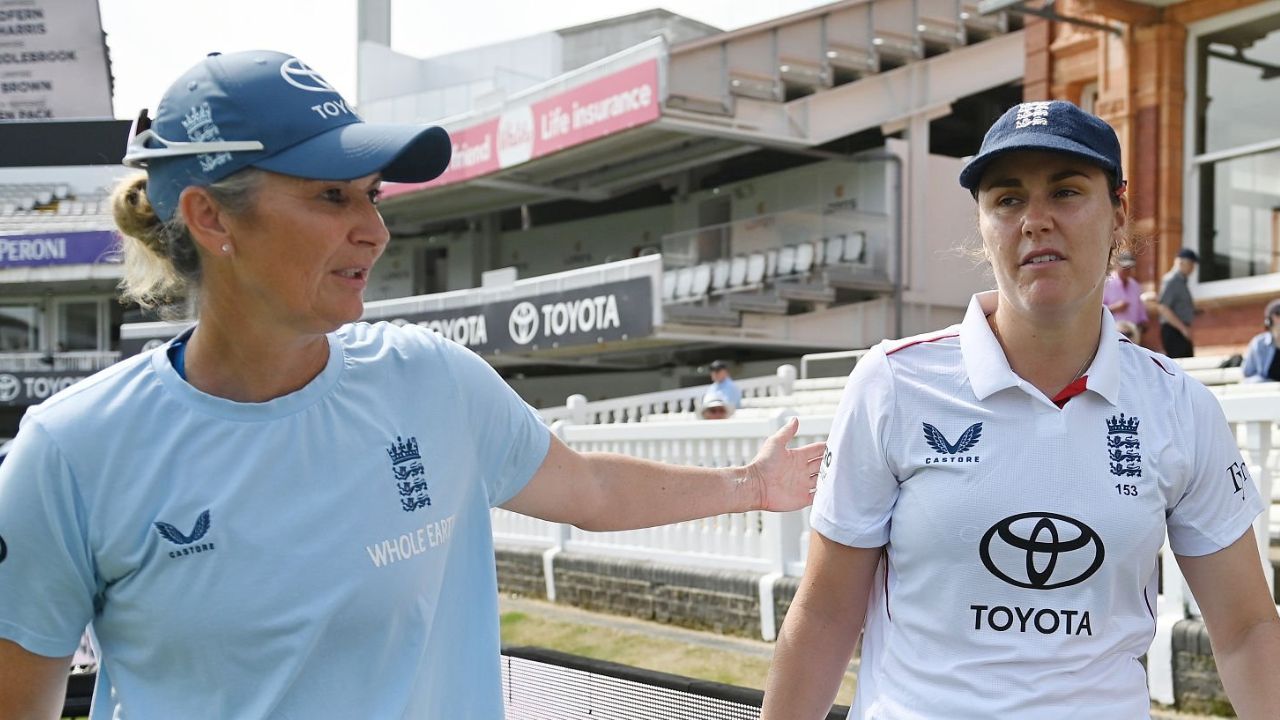
Charlotte Edwards has made no secret of the importance she attaches to the longest format. With the Ashes Test carrying four points, double the two available for each subsequent white-ball match, the England head coach has identified it as a central battleground in the multi-format series.
England’s New Roadmap to 2027 Ashes Test
The ECB’s plan is expansive. England will undertake a 10-day red-ball training camp in Bangalore in January, before playing four red-ball matches ahead of the Ashes opener at Headingley in June. Those fixtures include a three-day game against Australia A and three “best versus best” matches, designed to simulate Ashes conditions and give players a genuine opportunity to press their selection claims in English conditions.
The ECB has been clear that this is a performance-driven call rather than a financial one. Richard Gould, the ECB chief executive, said the revised programme would give Edwards and her squad “the appropriate game time to be ready” for the challenge of an Ashes Test. “Best versus best in English conditions provides a valuable opportunity for the team,” Gould said. “It also allows us to assess our strength in depth, give opportunities to more players and get a number of competitive multi-day cricket matches across a longer period into the wider group.”
That reasoning reflects a broader structural reality: England’s domestic calendar currently offers limited opportunities for players to accumulate sustained red-ball cricket. By creating a concentrated block of multi-day matches at home, the ECB hopes to build both technical readiness and depth before facing an Australian side with a formidable Test record.
Yet the decision comes at a price. A Women’s Test in the Caribbean has been sacrificed, denying West Indies a rare home red-ball occasion and removing an international Test from England’s schedule. The ECB acknowledged that accommodating its preparation programme required revising the tour, which will now take place after the English domestic season has already begun. “The ECB is grateful to Cricket West Indies for agreeing to its request, and for the understanding and collaborative approach taken in these discussions,” the board said in its announcement.
The context makes the concession more significant. Cricket West Indies announced in September a reduction in players’ retainer fees and the suspension of the men’s Super50 tournament and women’s T20 Blaze for the year, largely because of operational costs. Last month, ECB chair Richard Thompson indicated that his board could be prepared to fund a Women’s Test in the Caribbean to protect England’s Ashes preparations.
However, it is understood that England’s red-ball schedule was designed around performance rather than finances: the priority was a dense run of competitive multi-day matches in familiar conditions, not merely securing a Test abroad. England’s gamble is understandable. The Ashes Test is the highest-value fixture in the series, and England’s recent record in the format has been poor. A focused, home-grown preparation block offers a credible route to addressing that weakness.
But it also raises an uncomfortable question: if Tests are to be treated as the pinnacle of the women’s game, can boards afford to remove them whenever a major series approaches? England have chosen certainty and control over an additional international Test. Whether that trade-off delivers redemption at Headingley or deepens concerns about the sport’s shrinking red-ball calendar, will define the early chapters of their 2027 Ashes campaign.
(Quotes sourced from Cricinfo)

I am Yash Tailor, and I believe work should be driven by passion. Therefore, after completing my Engineering, I chose to work in the Cricket industry, my passion. My goal is to reach a stage where I truly enjoy what I do and give my best to every task with energy and purpose.